Showing posts with label virtual worlds. Show all posts

11 January 2023

Launching The Metaverse Series


David and regular Daden collaborator Prof. Maggi Savin-Baden have been appointed as series editors for Taylor & Francis' new series of books on the Metaverse - simply titled The Metaverse Series! More info at http://themetaverseseries.info/. David has already started on The Metaverse: A Critical Introduction.

The series aims to cover both "vertical" applications areas such as learning, training, the arts, digital twins, heritage, the military metaverse etc as well as cross-cutting issues such as identity, governance, psychology, ethics etc. See http://themetaverseseries.info/ for a provisional list.


16 August 2022

What Goes Into a Metaverse?


I've just posted a new article to Medium on What Goes Into a Metaverse? It updates a diagram and presentation I did for PICNIC in Amsterdam on the Metaverse back in 2008.


10 August 2022

1 November 2021

Jon Radoff's 7 Layer Metaverse Model and Market Map


Jon Radoff has an interesting "7 layer model of the Metaverse" at https://medium.com/building-the-metaverse/the-metaverse-value-chain-afcf9e09e3a7 and a mapping of the recent Facebook/Meta announcements at https://medium.com/building-the-metaverse/facebook-as-a-metaverse-company-d5712198b22d.

Needless to say we all have our own variations/comments on this. For me I think that Infrastructure/Decentralisation/Spatial should be the bottom 3 layers, and really the Human Interface should be the outer one - you don't (or shouldn't) build you virtual experience on the human interface, you should build the experience and then open up to as many interface types as you can. Discovery could perhaps be split between internal discovery (how you find out about stuff in the world) and external discovery (how you find out about experiences, and particularly how one experience links to another).  And should the Creator economy sit on top of the experience as in a true Virtual World prople are using the experience to create the economy, and then enhance the experience (so circular!). Perhaps something more like a network model would be more realistic (if less eye-catching) given the interconnectivities involved - it's not quite the ISO 7 Layer model diagram.

I'll have to dig out one of my old models.

Jon also has a Market Map of the Metaverse at https://medium.com/building-the-metaverse/market-map-of-the-metaverse-8ae0cde89696 - which is likely to be quite dynamic!


Jon also has a Metaverse Canon Reading Guide at https://medium.com/building-the-metaverse/the-metaverse-canon-reading-guide-9eb1b371b505


29 October 2021

Facebook (aka Meta) Connect2021


Me at Connect21 in Venues*

*although you could see the video in-world it deoens't show on the photos you take


I attended the Facebook Connect2021 event in Oculus (now Horizons) Venues yesterday afternoon. Struck me that there were a lot more people in VR than last time, around 1200 were meant to be there, although we were all sharded into ~ 20 people pods (and they were on 2 levels so you really only saw ~ 10).

Needless to say the whole name change thing and the relentless focus on the Metaverse made it a bit more weighty than the last one I went to which just introduced the Quest 2, but apart from Mark Zuckerberg finally "getting" virtual worlds there was really little there that wasn't being talked about 10 years ago. Sure the tech is moving on but there are still lots of areas which need to be sorted.


So here are my highlights/comments on the talk, in roughly timeline order.

  • Yep, pretty much everything talked about in terms of what you could do in the VW element of the Metaverse you could do in SL 15 years ago
  • The one big difference, and which would be cool, is the better integration of your desktop into VR and bringing your phone into VR so that you can stay in world whilst checking "RL" information or having chats with people in "RL"
  • Zuckerberg talked about the metaverse as being the "replacement" for the mobile internet, but I think despite the fancy nature of the "metaverse", even when implemented through MR glasses we'll still find the unobtrusive nature of the smartphone (along with battery life etc) to be valuable, so I think they'll just be parallel streams into the meta-metaverse!
  • He talked about interoperability in terms of being able to bring avatars and virtual objects between worlds - but it wasn't clear if this was between FB/Meta ecosphere applications only, or out to third party virtual worlds. I fear the former. At the ReLive conference in 2011 we highlighted interoperability as the key medium term need - and we're still not there!
  • Some nice quick videos of the various Horizons platforms, with Rooms going from single to multi-user, and it looks like Spaces will have a Scratch type scripting system, which will be great news as long as its powerful enough for decent work.
  • Also some nice hints about better tools to enable 2D progress web applications to display within the 3D/VR environment, further breaking the barrier between the 3D/VR and 2D/RL environments!
  • The whole presentation kept switching from RL to greenscreen to Horizons to smoke and mirrors, by the end I wasn't sure if Mark was really an avatar or not and you certainly couldn't tell what was real tech and what was marketingware.
  • There seemed to be a lot of emphasis on "holograms" and going to real concerts/meetings as holograms with real friends/colleagues. It was at all clear on how that was ever going to work, although the AR glasses would sort of make that feasible. Mind you having tried to stream a bit of video out of  a concert recently I can't see how the bandwidth will ever be there! Oh, virtual after parties - tick, done that, great one after The Wall show in SL "back in the day" actually on the stage set.
  • The lack of a VR keyboard in Venues itself (and most VR apps) was keenly felt as it meant that the dozen or so of us there could really interact whilst the session was going on. Meta may have a solution - see below.
  • A big announcement for the short term was that Oculus products will not now mandate FB accounts, so the concerns that many corporate/academic clients had might go away. They will also continue to allow sideloading onto Quest, so it looks like the Quest will remain a more open platform and not be locked down to FB/Meta - hurrah!
  • Lots of stuff on their "presence" SDKs to help developers better integrate controllers, MR /pas-through features and voice control. "Presence" was emphasised a lot, more than immersion (just like we've been telling a recent client!)
  • Project Cambria will be their next generation high-end headset, non-tethered but more expensive that the Quest, although they hope features will gradually drop down to the Quests. Hi-rez, colour pass-through to better enable MR applications seems the key differences, plus the sensors to detect facial expression and eye-movement for more natural avatar interaction, nice.
  • Project Lazare is their AR/MR glasses project, heading for full Hololens type MR but in a spectacles form-factor. This is what would make their "holograms" believable - as long as you put glasses on all the RL people.
  • A list of futures "breakthrough" areas for VW tech looked very generic, everything talked about was evolutionary, and interestingly was missing neuro-interfaces tech. 
  • Then he talked about neurotech (!), or specifically electromyography (EMG) and a device which looked suspiciously like the old Thalmic Labs MYO. Still have mine (see photo below). This senses what your fingers are doing from the electro-neural impulses picked up at the wrist. Some nice demos (?) of subtle gesture control, including typing. In theory you need hardly actually move your fingers at all. One of the more interesting things shown. Does it work for feet and locomotion too?
  • The Codec photo-realistic avatars looked quite good - volumetric and based on face/body scans, but with the ability to then change hair, clothes etc. The clothing demo and talk about hair modelling reminded me of how much we wrote about those areas in our Virtual Humans book.


My old MYO


Needless to say all the bad press side of Facebook, privacy and corporate greed didn't get a look in (although there was a snide comment about high-taxes (!) stifling growth and innovation), but he did use the words "humble" or "humbling" more times than I could count, and Nick Clegg popped up for about 30 seconds to say not very much. As some of our recent work has highlighted for a client VR offers unparalleled insights into personal behaviour and its vital that our explicit and implicit data is secure and not being exploited, and the "metaverse" is not under the control of one company. If Facebook was really serious about the metaverse they'd open source the whole lot right now.

You can watch the presentation for yourself at https://www.youtube.com/watch?v=Uvufun6xer8&ab_channel=Meta

Full set of Connect21 presentations on the more technical side at https://www.facebook.com/watch/113556640449808/901458330492319/

Update: Looking at the World Building in Horizons video it really is very low rez at the moment, possibly even less than Hubs, and talk of strict performance limits. So good for some stuff but a whole load of use cases wiped right out (for now) :-(


15 March 2021

David Burden on the Dr Zero Show

Daden MD David Burden was interviewed about virtual worlds and virtual reality on the Dr Zero YouTube show hosted by Serdar Temiz over the weekend. David's piece starts at 34:42


20 November 2020

Revisiting AltSpaceVR


I haven't really been in AltSpaceVR much since we were doing some data visualisation experiments with its wonderful (but now I think discontinued) Enclosures feature - such as this pic of visualising USGS Earthquake data though an AFrame web page into AltSpaceVR). And this was back before the rescue of AltSpaceVR by Microsoft.

So it was fun to spend some time in there this week and see what's going on. The initial driver was an ImmerseUK informal meetup, held on the Burning Man site - some nice builds and all very reminiscent of SL circa 2008.


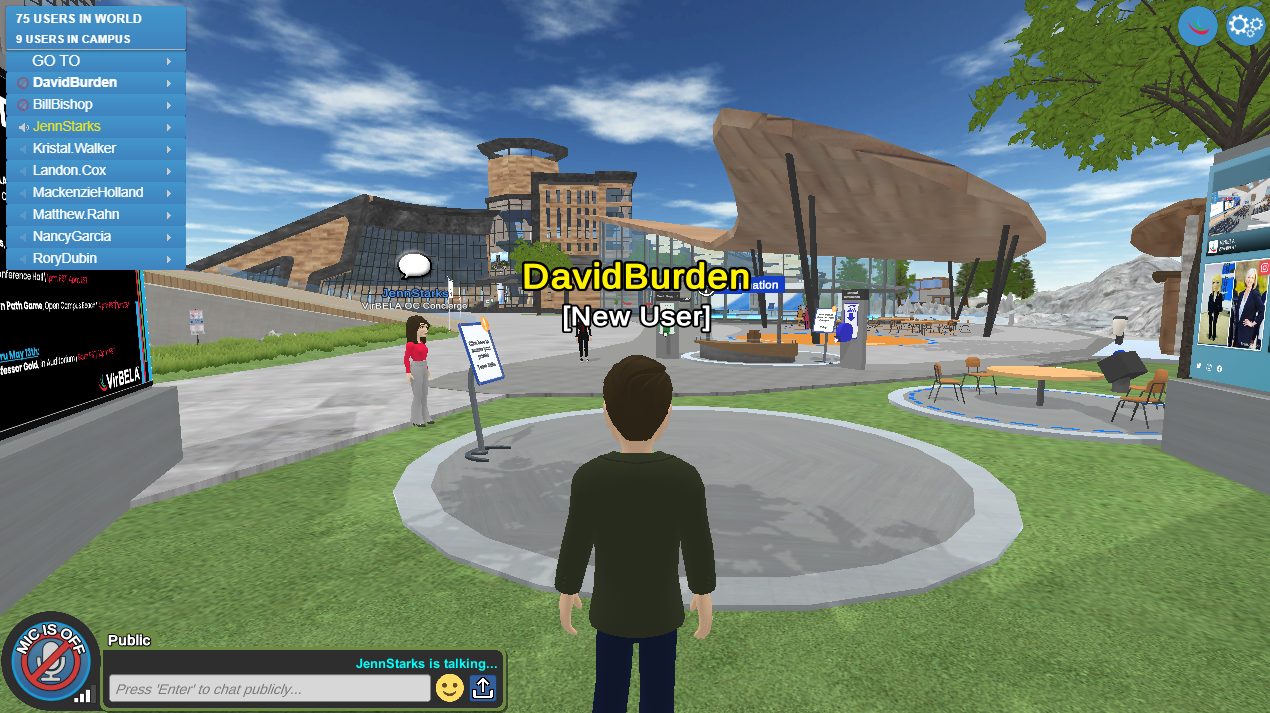
The avatars are less blocky than the originals, but still deliberately cartoony, but better proportioned than the VirBela ones. Things I liked (this was all via Oculus Quest):

  • Voice seemed pretty seamless
  • Very much an "SL" type experience
  • Big spaces to explore
  • Point-and-click movement was functional
  • The simple interactables (eg fireworks) were fun
  • Tutorial was good, and quick and easy to install on Quest
  • The barebones Friends system let you message and send Teleport lures
  • The menu disc worked pretty well, and pics were available from the web and didn't need downloading from the Quest
  • There is flying
Things I was less keen on:
  • When you do joystick movement your field of view is blinkered to about half - totally wrecking any immersion and making it hard to keep track of people you are following. This one issue alone makes me reticent about doing much else in the world - which is a pity
  • Rotational movement is in degree blocks not smooth - again destroys immersion and you temporarily lose your sense of location
  • When you fly your still vertical
  • No run ability - lost of multiple point-and-clicks the only answer
So a pity, if it wasn't for those basic movement issues it would be a pretty good place.

The next question for me of course was can I build there? AltSpaceVR has the concept of Universes and Worlds. The Burning Man thing was a Universe, and then each of the artistic sites you went to from it were Worlds. I think its hierarchical, so one world has to be part of one Universe, and access/permissions is controlled by the Universe owner, but I think can then vary between Worlds.

As a user (think you have to click the Beta Programme and Worlds boxes) you get a default Universe which contains your "home" World where you start each time - so you can customise that which is nice. From the web you can then create new Worlds (and I guess new Universes), choosing a starting template (you cant do this from VR). You then go into VR, and choose the World you want to go into and edit.

The main edit panel


Most templates have the same low-poly look as the rest of AltSpaceVR, and most are single room type size- although some are bigger. From the edit menu you can edit the objects in there, change the skybox, and then place new objects. There is quite a good library of objects already (arranged into sets), and you can import individual objects in glTF format. Textures/images can be loaded too - but a lot of this import looks like its via the web interface.

I found most of the templates too claustrophobic so I loaded one which is just a skybox, then rezzed a plane object and made it 50m+, so I started to have a nice place to play with. I then tried placing some objects from the libraries to get a feel for the thing. Manipulation in 3D/VR was OK but not as quick as 2D, and I'd hate to do precision work in there. There's also no scripting at present. Anyway here's a few pics:


The really interesting thing (for us) is that since AltSpaceVR is built on Unity the object sets are just Unity Asset Bundles, and there is a community built importer for them - as well as for location templates. And of course Trainingscapes also uses Unity, and Unity Asset Bundles for locations and inventories. So it might "just" be possible that we can import Trainingscapes assets into AltSpaceVR. Of course with no scripting there's not much we could do, but if there was some simple scripting and a basic API then possibly we could keep the Trainingscapes "engine" on the web, and play the exercise in AltSpaceVR - just as we used to with SL! Of course even though our builds tend to be relatively low poly they are nowhere near as low as AltSpaceVR - so that may be a blocker or just kill performance, but is might be worth a try.

Otherwise it's good to see how AltSpaceVR has come one, and if they fix that blinker issue I might be tempted to come in and build some meaningful spaces - and I'll certainly look out for some decent events and gatherings to join in world - far closer to an SL experience than VirBela or EngageVR for me ( but then that's more what its designed to be).


27 August 2020

Virtual Reality - A Future History?

 A few days ago I got together with a group of experts in 3D immersive learning and virtual reality and together we brainstormed what we saw as the major challenges facing 3D immersive learning/training and VR over the next decade or so.

The graphic below summarises our thoughts.

In the short-term (0-3 years) we identified the big challenges as being:

a) To make access easy and seamless. If people are going to use these environments they’ve got to be dead easy to use, and for organisations dead easy to manage. Oculus Quest is a good step forward (totally self-contained, automatic roomscale sensing), as is WebXR (no need to download to a headset or PC). But even within the experience, the “grammar” of how you navigate and use and interact with the space has got to be self-evident and common-sense. And no crashes or glitches or other “odd” happenings otherwise any sense of immersion is totally lost. And they need to integrate with your other digital presences - be that your desktop or work/social media accounts.

b) To make the applications desired. People and organisations have got to want to use this stuff. There has got to be user pull. For entertainment the experience has got to be worth all the hassle of setting up and clearing a space and totally isolating yourself from reality for a while, otherwise a film on Netflix or a game on Steam is going win out. For organisations the benefits of virtual learning and training have got to be clear and well understood. Yes there are lots of different case studies that show the benefits, but they aren’t well distributed or consolidated, and often aren’t too rigorous when comparing to BOTH the main alternatives (physical training and 2D eLearning).


In the medium-term (5-10 yrs) we identified two major challenges:

a) Mobility. Immersive learning needs to be available where and when people want to use it - it needs to be mobile. Yes an Oculus Quest is pretty mobile (I’ve even used it in my garden!), but in normal, non-COVID times, it's not feasible to use it on the bus or train into college, or sat in a cafe (locked away from the outside world with a purse or laptop ready to be stolen by your side), or sat on the sofa with half an eye on Love Island. Headset Mounted Display (HMD) VR needs to be complemented by mobile/tablet (and even laptop) based versions of the same experience. Yes there are advantages to HMDs (visceral immersion, scale, isolation), but there are also disadvantages (social isolation, nausea, convenience, cost). The user should decide HMD or non-HMD, not the software developer or trainer. 

b) Integration. We need to move away from walled gardens and towards standard based environments and applications. VR today is a bit like the pre-web Internet, different walled gardens, different access devices, multiple accounts. Users don’t want that - they want to hear about something and just access it with whatever device they have to hand, and with their long-standing personalised avatar. WebXR is helping here, and yes even the web still has many of these issues, and I know that asset wise we have broad portability between the platforms, but not in the scripting of the experience, or the management of the data associated with it. And does the “virtual world” approach of Second Life and Snowcrash offer a better model than the “app” approach of most current offerings. Many have talked about the Metaverse or Multiverse, being able to seamlessly (that word again) move from one virtual environment to another. There have been metaverse initiatives in the past - is it time for another one?


For the long term the group again identified 2 main issues:

a) Radical Interfaces. The VR HMD is a great step forward, but they are  still large, clunky, moderately uncomfortable for prolonged use, and not very portable. I’m pretty convinced that we need another big step change in HMDs before they become real consumer items where everyone one in they way that they currently (probably) have a tablet. What I have in mind is more like the holobands of Caprica than the Quest. Something that integrates VR, AR and MR, lets us readily see the physical world, tracks our hands, and, perhaps most important, manages to give us the “feeling” of locomotion, and perhaps the other senses. My guess is that this is as much a neurological interface as it is a visual one, and hence probably a decade or more out. 

b) Societal Change. VR is not just impacted by attitudes to it, but could also impact society itself. COVID has made us re-evaluate remote working and remote relationships. Popular media is full of stories based around virtualised people and places (Devs and Upload being just the latest examples). Even a decade ago virtual worlds were being used by hostile actors,  I doubt today’s environments are any different. How would a Caprica style virtual world, readily accessible by all, and with the capacity to do almost anything effect the way we all live and interact? Would it be for good or ill - and would it let us weather a second COVID that much better?


So there you are, 6 perspectives, 2 each for the short, medium and long term. You may not agree with all the details, but I hope that you can appreciate the general thrust of each, and each offers a timely call to action for the VR community.


Now scroll down a bit.


OK, I told a little white lie at the beginning there. The gathering of immersive learning experts wasn’t a few days ago, it was about 3,285 days ago at the ReLive (Research Into Learning in Virtual Environments) Conference. held at the Open University way back in 2011. Here's the original graphic - and you can find a fuller presentation I did later that years based upon it at https://www.slideshare.net/davidburden/virtual-worlds-a-future-history


But I think you’ll agree that the general vision and issues being raised back in 2011 differ little from what a similar analysis would yield in 2020 or even early in 2021 - ten years later! Some of the specifics might be different, and my commentary above reflects a contemporary take, but the big picture items are pretty much the same:

  • This stuff still isn’t seamless, although with Quest and WebXR we’re taking some great strides
  • The entertainment and business case is still struggling to be made. I know that Quests sold out early in lockdown, but I’ve also seen numerous reviews of technology to help with lockdown that haven’t even mentioned VR and immersive 3D.
  • We’ve actually made great strides in mobility if you consider non-HMD VR, I can now run avatar style experiences quite happily on my phone or tablet if they’re not too high-rez, and Quest again helps with instant set-up, but it’s still much of an either-or choice.
  • Integration seems further away than ever as VirBela, Immerse, AltSpaceVR, Sominium Space, Hubs etc all compete for users.
  • Radical interfaces is actually the one we achieved first, I was in SL in an Oculus DK1 in 2013, only 2 years after ReLive2011 - but as mentioned above there is still a long way to go for the ordinary consumer.
  • Societal change may be driven as much by COVID (and the fear of similar future outbreaks) and climate change, but VR is having far more of an impact on popular culture than it did a decade ago, and that triumvirate of VR capability, external pressures and cultural exemplars may well be driving change more quickly - although perhaps not a quickly as we thought back in 2011.


So I hope you’ll forgive my little deception, but I thought it might be a nice way to not only to illustrate how many things have stayed the same despite the apparent “improvements” in technology, but also highlights how much there is that current VR practioners can learn from the work on immersive environments that was being done a decade ago. For inspiration just check out the agenda and papers from ReLive11 (and the earlier ReLive08), still available on the OU website.

18 May 2020

DadenU Day: Virtual World/VR Conferencing


For my DadenU Day I decided to check out some of the VR virtual conferencing environments which are around at the moment (apps seems too limiting, but they lack the agency and persistency to be worlds). I managed to squeeze 4 into the day: EngageVR, VirBela, SomniumSpace and Mozilla Hubs. All comments are based on about an hours play in each, so I may well have missed or misunderstood features.

EngageVR


EngageVR (https://engagevr.io/) is the one that seems to be getting the most attention at the moment, and it is pretty slick. Although primarily aimed at VR the 2D/3D interface is fine, and recognises that a lot of people who want to do this sort of virtual conference don't yet (or ever will) have a VR headset.

After a nice avatar designer your dropped into a virtual lecture theatre for a basic tutorial. All "experiences"/environments are accessed through a Oculus style home space and tiled menu. As well as watching a recording (see below) of a panel debate I also wandered around Mars and the Moon (obligatory for VR).

The basics work really well, but the positives that really stood out were:

  • Your avatar has arms as well as hands, and the IK is pretty good
  • You have feet, and legs! When you walk your legs sometimes hang doll like, but other times they get traction and try and walk (although often more slowly than you!). The neatest trick though is that if you bend down your knees bend - even though there is no knees/leg tracking!
  • You can record a session. This records the 3D data, not the visuals. This means if you replay it you are still in the space and see the action unfold around you (as in the panel session). Really weirdly if you've recorded yourself moving around so see yourself moving - from your "current" avatar - you have a clone! Not sure how many times you can repeat this trick!
  • Load times impressively fast

On the negatives:
  • All content is built by/through Engage, so you have minimal agency beyond what the experience lets you have. An "author" mode is promised. So whilst on Mars I could rez a dinosaur and click on points of interest on Curiosity that was it.
  • There is a big difference between the 2D/3D graphics (great) and the Oculus Quest graphics (lower rez) - particularly noticeable on Mars. Obvious impact of the lower memory and power of the Quest headset, but a reasonable way of addressing it.
  • Had to sideload onto Quest - but manageable through Sidequest.
  • Didn't spot text chat (which would be hard in HR, but near essential in 2D/3D)

Overall a very impressive platform, and one which we'd probably have clients consider if there focus is more on 3D/VR events than training.

VirBela


Seen quite a few VirBela (https://www.virbela.com/) events being held recently - Laval Virtual in particular. The whole place has a deliberately cartoony look, and feels a bit like ActiveWorlds did in the late 90s, but with more doll like avatars. Again there's a quick avatar designer and then you arrive at a central plaza (very AW). No tutorial or anything. Information boards tell you a bit about the place and what you can do, and you can TP to example private office suites.

Pros:

  • Very easy set up and access
Cons:
  • VR only on pro
  • Cartoony look probably wont suite most corporate (UK) users
  • No agency or building, very much for virtual meetings/conferences

Overall simple but works well, but not sure the look is for most of our clients.


Somnium Space


I keep hearing about this one (https://www.somniumspace.com/), and wasn't sure what to expect. Overall it felt a bit like Second Life Alpha c.2004 (actually not that good) or early High Fidelity. It is very aiming at a persistent VW rather than a conference/training space. Huge download, and VR promised for 2020. There is scripting (LUA?) and building a la SL, but it that's what you want why not just to go to SL. They also have an SL like land model, although backed by blockchain. I guess they'd say their differentiation is blockchain (so what) and VR building (when it comes). If SL had VR then I think any need for SS would just disappear. Couldn't really get much to work, and very laggy. Maybe check back in a year.

Trying to build/terraform

Mozilla Hubs


Again heard a bit about this one (https://hubs.mozilla.com/#/). Feels like Google Lively more than anything else. Very angular and low rez, and a weird perspective so its hard to tell if an object is small and close, or big and far away! Trying to build anything complex would be a pain. You can though just drop in objects from Google Poly or Sketchfab. Probably more of a fun space to get kids to build things in, and people are using it for more serious work, but probably not for most of our clients. Be an interesting challenge to build a very "serious" space in it though.

A more "serious" space - til I brought the Elephant in!

The avatars are trunk and head only.


Comparing to Trainingscapes

Coming back to Trainingscapes after those 4 actually felt quite liberating. Would love to have EngageVrs recording and avatars, but would probably trade that for the ability to build and create things (which any non-student account can do) and have agency. And for persistence SL still seems streaks ahead. But I can certainly see that EngageVR (and possibly for the right client VirBela) would be a good option for clients after virtual meetings conferences. But then again if they want to do more than sit and listen they're stuck - so not really for collaborative activities, you couldn't do this for instance:


There's also no sign of any of them working on mobile/tablets which Trainingscapes does!

I'll try and test out a few more worlds this week, and then dive back into SL/Open Sim.


30 August 2017

Gartner Hype Cycle 2017 - A Critique

Every year the Gartner Group (well known tech analysts) publish their "hype-cycle" - showing whereabouts emergent technologies are on the journey from first conception to productive tool. We've watched Virtual Worlds ( and then Virtual Reality) work its way along the curve over the last decade, but this year's chart has a number of interesting features which we thought might be worth discussing. We focus here only on the areas of keenest interest to us at Daden, namely AI/chatbots and 3D immersive environments.

First off, it's interesting to see that they have VR now pulling well out of the Trough of Disillusionment, and only 2-5 years to mainstream adoption. This seems reasonable, although a more detailed analysis (which we may do later) would probably put VR in different sectors at different points on the cycle - so whilst this position seems OK for gaming and training I'd be tempted to put it still up on the Peak of Inflated Expectations when it comes to mass media entertainment or personal communications.

As a side-line it's interesting to look at these two Gartner charts from 2012 and 2013. Spot the difference?

2012 Hype Cycle

Clue - look at the Trough of Disillusionment....

2013 Hype Cycle

In 2012 Virtual Worlds (Second Life and it's ilk) were at the bottom of the Trough, in 2013 (as the Oculus Rift hype started) they were replaced by Virtual Reality! Virtual Worlds (and SL) are still around - although often rechristened Social Virtual Realities - and we'd guess they are still lingering in the Trough as their potential is still a long way from being realised.

One tech that was in 2016 but is missing from 2017 is Virtual Personal Assistants. Now if we take this to mean Siri, Alexa and co that seems reasonable - I have Siri in my pocket and Alexa on my desk as I write. But they are a far cry from the virtual PAs that we were promised in the mobile phone videos of the 90s and 00s. In fact if we compare the 2012/2013 and 2017 charts we can see that "Virtual Assistants" 4-5 years ago were just over the Peak, but now in 2017 "Virtual Assistants" is actually just approaching the Peak! So Gartner appear to have split the old Virtual Assistant into a simpler, now mainstream, Virtual Personal Assistant, and a new Virtual Assistant representing those still hard to do elements of the 1990s vision.

Back to 2017 - the new entrants on the Hype Cycle of interest since 2016 are Artificial General Intelligence and Deep Learning. Deep Learning is really just a development of Machine Learning, and its interesting that they have them both clustered together at the peak. In fact I'd have thought that Machine Learning is probably approaching the plateau as it appears to crop up everywhere and with good results, and Deep Learning is not far behind. Interestingly neither appeared on the 2012/13 charts!

Artificial General Intelligence is far more interesting. It's been mooted for years, decades, and progress is certainly slow. We'll be writing far more about it in coming months but it is a lot closer to what most people call "AI" than the things currently being touted as "AI" (which are typically just machine learning algorithms). As its name suggests its an AI which can apply general intelligence (aka common sense) to a wide variety of problems and situations. Gartner have it about right on the chart as its still a back room focus and hasn't yet hit the mainstream media in order to be hyped - and still seems decades away from achievement.

There are some other technologies of interest on that initial slope too.

It's interesting that Speech Recognition has now gone off the chart as a mainstream technology - whilst it may not be 100% yet its certainly come on in leaps and bounds over the last 4-5 years. But was is in the initial slope is Conversational User Interfaces (aka chatbots) - divorcing what was seen as the technical challenge of speech recognition from the softer but harder challenge of creating a Turing capable chatbot interface. I'd have thought that the Peak for CUI was probably some years ago (indeed Gartner had Natural Language Query Answering near Peak in 2013) and that we've spent the last few years in the trough, but that intention based CUI as we're seeing with Alexa and Messenger are now coming of age, and even free text CUI driven by technology such as Chatscript and even AIML are now beginning to reach Turing capable levels (see our recent research on a covert Turing Test where we achieved a 100% pass rate). So I'd put CUI as beginning to climb the slope up out of the Trough.

By the way, we got excited when we saw "Digital Twin" on the chart, as it's a subject that we have a keen interest and some involvement in. But reading their definition they are talking about Internet of Things "digital twins" - where a piece of physical equipment has a virtual simulation of itself which can be used to predict faults and ease maintenance and fault finding. Our interest is more in digital twins of real people - cyber-twins as they have been called - perhaps we'll see those on later charts!

The final technology of interest is Brain Computer Interfaces. Putting them only just behind Conversational Interfaces reinforces the point that CUI should be a lot farther through the cycle! Useful Brain Interfaces (I'm not talking Neurosky type "brain-wave" headsets here - Gartner may differ!) still seem to be decades away, so sits about right on the chart. In fact it's moved a bit forward since 2013, but still at 10+ years to mainstream - can't argue with that.

So all this is pretty subjective and personal, and despite its flaws the hype cycle is a useful model. As mentioned though the same technology (eg VR) may have different cycles in different industries, and we also feel that each point on the curve is a bit of a fractal - so composed of smaller versions of the cycle as each step forward gets heralded as a great leap, but then falls back as people actually get their hands on it!

We look forward to reviewing the 2018 chart!


25 August 2017

Project Sansar - First Impressions


I've been signed up the Sansar Closed Beta for months but other projects meant I never had the time to go play. Now it's in Open Beta (and so we can talk about it) I thought it was about time I checked it out.

What Sansar doesn't offer (in comparison to SL) is a single shared world - this is far more a "build your space and let people visit" model. It also doesn't offer in-world building (just placement of imported or bought object), or in-world scripting (and scripting is in C++ and needs to be re-imported everytime you make a change, so it looks like a very long development cycle!). What is does offer is (as did SL) is multi-user (well at least multi-avatar), and VR support out of the box. Avatar choices are limited but look OK with some nice facial customisations, but only about 8 outfits (and no colour options!).

VR and using the teleport movement - see light beam

The navigation model is horrendous (in my view) - the camera usually giving a sideways view til you'd been walking for ages. You couldn't use cursor keys to rotate your view on the spot - very much built for gamers with keyboard in one hand, first person view and mouse in the other. Couldn't find a run or fly control so walking around too ages. There is a nearby-TP option where you can point to a place and jump there - but a very short range.


The actual spaces looked pretty good - but they are just imports of 3D models so no reason not to. But interactivity was non-existent in the ones I saw - probably due to the complexity of the scripting. Almost all of them also seemed very dark - they give you lights for your scenes but it seems like many people aren't using them well.

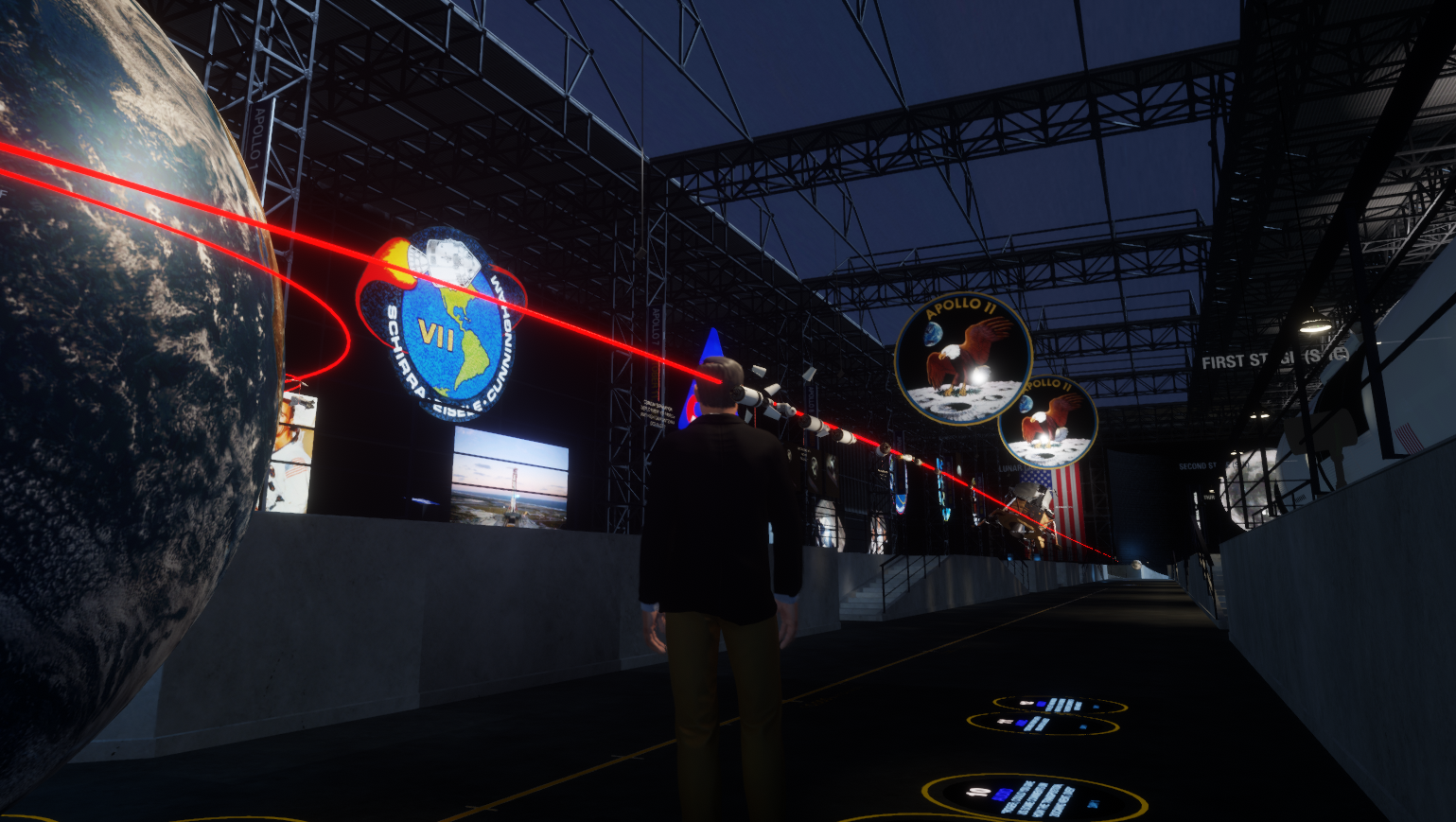
The one location that was stunning (especially in VR) was the Apollo Museum - with a really nicely done earth-moon trajectory and little CM/LEM models all along it and audio to show you what was going on - a superb VR demo.


Having done a quick tour I decided to try building so chose one of the ~8 base locations. Rather than buy from the store I decided to upload some FBX models - which was pretty smooth except for the fact that it appears they only get textured if the textures are PNG - and even then the ones I tried ended up all candy-striped!


One of the biggest issues for me though was that you had no avatar when building - so lose all sense of scale. No issue if you're a 3D artist, but for an SL renegade like me I can never get on with building without myself as a reference. Once you've done the build you save and then "build" - which can take a minute or so, before you can play (another minute or so), so again a slow iterative build process (and the "professional" builds were taking ~5 mins each to download.

Finally I wanted to try scripting. Before I started this morning (as as I tweeted) I thought I might be able to get a Sansar script talking to the bot I was working on, or even one of our PIVOTE APIs. No chance! Sansar scripts are pure C#. It seems at the moment you must edit outside (Notepad or Visual Studio), then import, attach, then build then run - it would take ages to do anything. The C# calls to interact with the environment also look non-trivial (subscribing to changes etc), and only a small subset of Mono/C# functions are supported - not the range that Unity has - so no web calls! There's no way that people will have an easy transition from LSL to Sansar CS - it's a whole extra level up.


So overall - massively underwhelmed. High Fidelity certainly looks far more interesting from a technical standpoint and is closer to an SL#2 - but even that doesn't have the single world thing. AltSpaceVR (if you added object import/placement) is far closer to what I thought that Sansar would be - and the WebGL enclosure idea was/is a superb way to create interactive 3D/VR content at minimal effort. The whole Sansar experience felt like working through treacle, whether exploring or building, - although in first person in VR at least the explore bit was quick.

What it did make me appreciate is what we've done with Fieldscapes. Using that has never felt slow. Its very quick to layout, add interactivity, test and explore - things just flow. And if people want to spend the time then there is no reason why you shouldn't have the same level of eye-candy as the Sansar spaces. But there is just no way that I can see Sansar being a training/education tool - you'd use native Unity or Fieldscapes or something similar, more power or higher ease of use, rather than Sansar which appears to cripple both. And the spaces don't have the immediacy of the AltSpaceVR ones, or the ease of build of the SL ones, so I don't see more casual users taking to it in great numbers. Perhaps if I had loads of time, was a coder/3d artist and wanted to build some sort of fan-space it might be a place to do it, but somehow I doubt even that.