Showing posts with label medical. Show all posts

6 June 2022

Effect of Non-Immersive Virtual Reality Simulation on Type 2 Diabetes Education for Nursing Students: A Randomised Controlled Trial


A nice paper that we co-authored with Heidi Singleton form Bournemouth University on her Diabetes project in VR has finally seen light of day. You can read it on open access at:

https://www.nursingsimulation.org/action/showPdf?pii=S1876-1399%2822%2900016-0

The abstract is:

Background: A virtual reality simulation was used to teach treatment of diabetic patients.

Methods: This study evaluated the impact of using virtual reality on short term knowledge of hypoglycaemia, via pairing of a randomised controlled trial, analysed via Partial Least Squares-Structural

Equation Modelling. The setting was two large lecture theatres based at campuses within the UK. Second year nursing students (n = 171) volunteered to take part in the study. Students were randomised into two groups, control (n = 88) and experimental (n = 83). The trial enabled comparison, via preand posttest surveys, of the simulation with normative teaching methods.

Results: VR was found to be significantly (p ≤ .001) better in terms of hypoglycaemia knowledge than normative methods. The method also enabled identification of the key point of action of the simulation, which evidenced that the “engagement to immersion” pathway was responsible for leading to higher knowledge scores in the experimental group.

Conclusion: This paper claims addition to knowledge about how the novel approach taken has the potential to deepen understanding of how virtual technologies can affect learning in nurse education.

https://doi.org/10.1016/j.ecns.2022.02.009.


7 December 2020

New Case Study - A VRLE For Midwifery Students


Over the last year or so we've delivered 3 simulations for use by midwifery students at Bournemouth University as part of a Virtual Reality Learning Environment (VRLE) project. The exercises cover:

  • A Urinalysis appointment at a clinic with an expectant mother
  • A home visit to do a routine post-birth baby & mother check and a check on safeguarding issues
  • Dealing with a post-partum haemorrhage in a hospital ward
Student responses have included:

  • “It is a different and enjoyable way to learn"
  • “I think it is a good way of demonstrating what it is like to be in someone else’s shoes.”
  • "The VRLE is a really useful learning tool that I hope is continuously used throughout the duration of our course.”

  • You can view a video presentation on the exercises by BU project lead Denyse King on YouTube:


    Detailed results will be published in Denyse's doctoral research but “the evidence gathered from 311
    healthcare students demonstrates that VRLE have a statistically significant positive impact on: learning, confidence, clinical intuition, humanisation of healthcare and students’ perceived positive onward impact on service user safety.”

    Our latest case study summarising the project is also now available - just click to download.

    10 September 2018

    Trainingscapes at the EU40 BBQ


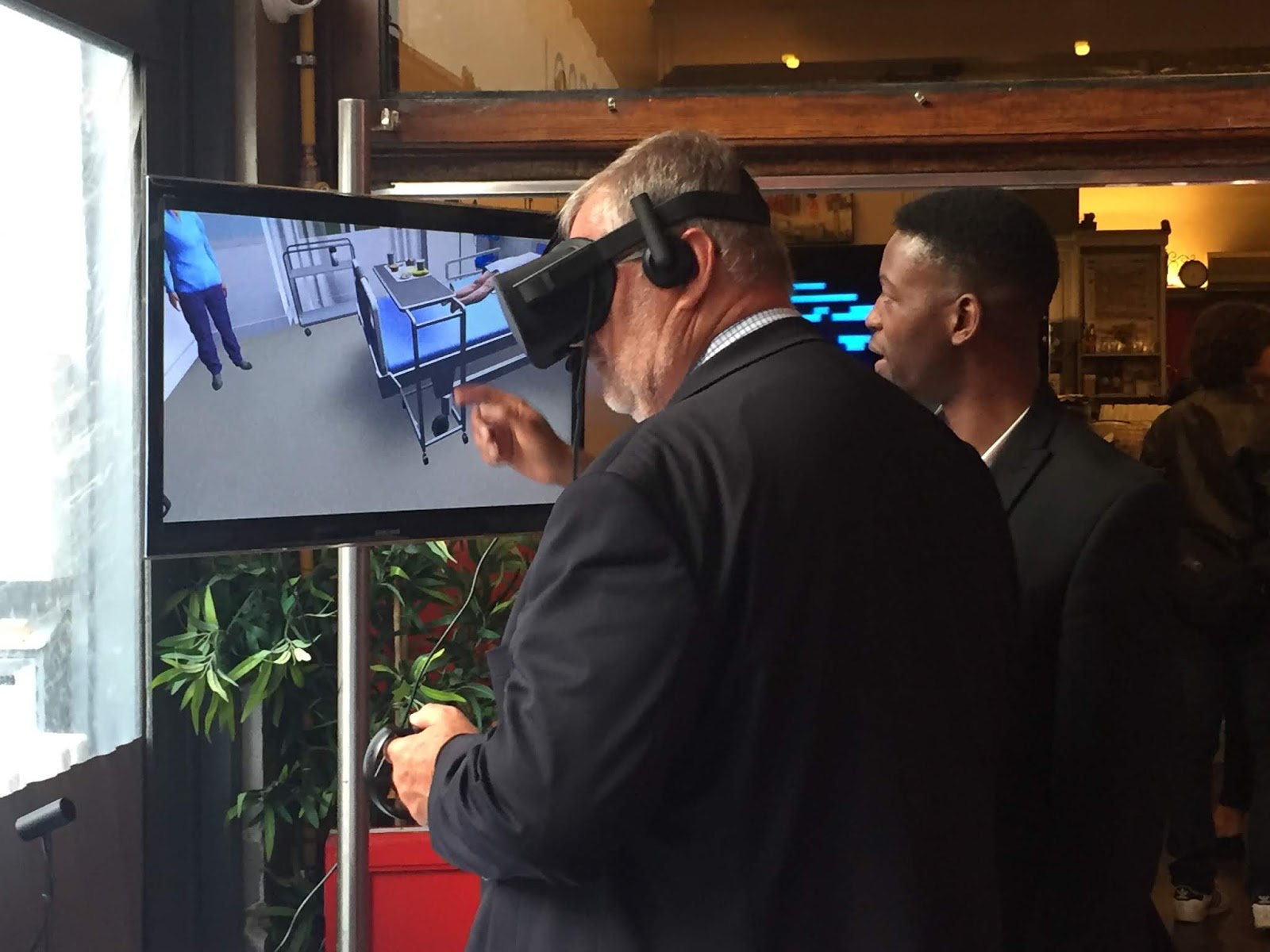
    MedtechEurope CEO Serge Bernasconi tries out Trainingscapes

    David and Nash headed over to Brussels last week at the invite of MedTechEurope which was sponsoring the annual EU40 BBQ and wanted to show MEPs how innovative technology such as VR is being applied in the medical and health arena.

    EU40 is the platform of young Members of the European Parliament and of the 28 EU national parliaments. Their mission is to serve young Members under the age of 40 and strengthen their role inside the European Parliament by adding aesthetics, fun and fresh ideas to European politics!


    MedtechEurope started as an alliance in October 2012 formed by two organisations - EDMA, representing the European in vitro diagnostic industry; and Eucomed, representing the European medical devices industry. MedTech Europe engages with EU regulators, politicians and other decision-makers to help shape policies to promote innovation for our growing healthcare needs and expectations. Its aim is to encourage policies that help the medical technology industry meet Europe’s growing healthcare needs and expectations. It also promotes medical technology’s value for Europe focusing on innovation and stakeholder relations, using economic research and data, communications, industry events and training sessions. MedTech Europe’s mission is to make innovative medical technology available to more people, while helping healthcare systems move towards a sustainable path.


    Despite the torrential rain during set-up we had a great time letting attendees work through a version of the Diabetes training application that we've just done for Bournemouth University. We also had the same app running on an iPAD to show that VR headsets aren't mandatory. We also had some pharma data in 3D on Datascape running on Google cardboard to show another use of the VR technology.


    All in all a great evening, and our thanks to MedTechEurope for inviting us.


    28 September 2017

    Fieldscapes and Midwifery Training at Bournemouth University


    As you may have seen from our Fieldscapes Twitter stream we've just reached the delivery stage of our first Midwifery Fieldscapes lesson (on Urinalysis) for Bournemouth University's Midwifery training team. We had a number of meetings with the team over the summer and then went away and customised our existing Simple Clinic space into "Daden Community Hospital", and added more generic medical props, and also brought in some BU specific posters. Nash then created the first exercise based on an agreed flowchart/storyboard and now we're just getting to the end of the iterations with the team, stakeholders and students. The final step for us will be to train the BU team on how to use Fieldscapes to continue to maintain and develop the exercise (and create other exercises), before they then start their evaluation with the current student cohort.


    Response so far from all involved has been excellent with comments such as:

    • "I had such a cool day at work recently – I got to play with the first of my VR healthcare education environments using Oculus Rift"
    • " I absolutely love this! A brilliant way to learn" - student feedback
    • "So amazing to see my project becoming a reality – I hope the students love this way of bridging the gap between classroom theory and clinical practice"
    • "That was brilliant loved it! can’t wait to do more. Very informative" - student feedback
    • "Delighted that the Oculus Rift dramatically altered the look and feel of the clinical room, and that the handheld Haptic feedback controls added to the experience"


    Being Fieldscapes the exercise can be experiences on a PC/Mac or Android device, and in VR on Oculus Rift or Google Cardboard on Android. One of our final tasks is integrating one of the £2-£3 hand controllers for the Cardboard go go along with the c.£15-£20 VR-BOX headsets that BU have (VR doesn't have to be expensive!).


    We'll keep you posted as developments and evaluation progress and we're already talking to BU about other exciting way to take the training.


    You can read more about the BU view on the project on their blog posts at: