Showing posts with label futurology. Show all posts

26 September 2017

The Three Big Challenges in AI Development: #2 Generalism and #3 Sentience


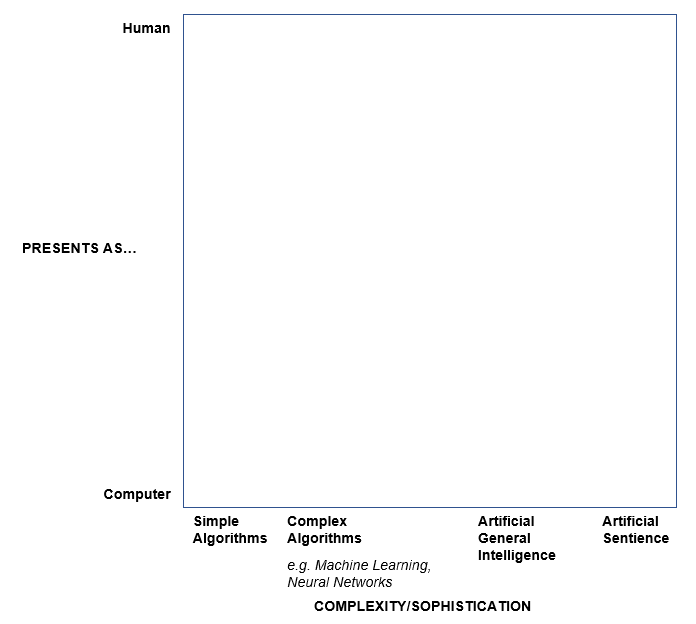
Following on from the previous post I now want to look at what happens when we try and move out of the "marketing AI" box and towards that big area of "science fiction" AI to the right of the diagram. Moving in this direction we face two major challenges, #2 and #3 of our overall AI challenges:

Challenge #2: Generalism

Probably the biggest "issue" with current "AI" is that it is very narrow. It's a programme to interpret data, or to drive a car, or to play chess, or to act as a carer, or to draw a picture. But almost any human can make a stab at doing all of those, and with a bit of training or learning can get better at them all. This just isn't the case with modern "AI". If we want to get closer to the SF ideal of AI, and also to make it a lot easier to use AI in the world around us, then what we really need is a "general purpose AI" - or what is commonly called Artificial General Intelligence (AGI). There is a lot of research going into AGI at the moment in academic institutions and elsewhere, but it is really early days. A lot of the ground work is just giving the bot what we would call common-sense - just knowing about categories of things, what they do, how to use them - the sort of stuff a kid picks up before they leave kindergarten. In fact one of the strategies being adopted is to try and build a virtual toddler and get it to learn in the same way that a human toddler does.

Whilst the effort involved in creating an AGI will be immense, the rewards are likely to be even greater - as we'd be able to just ask or tell the AI to do something and it would be able to do it, or ask us how to do it, or go away and ask another bot or research it for itself. In some ways we would cease to need to programme the bot.

Just as a trivial example, but one that is close to our heart. If we're building a training simulation and want to have a bunch of non-player characters filling roles then we have to script each one, or create behaviour models and implement agents to then operate within those behaviours. It takes a lot of effort. With an AGI we'd be able to treat those bots as though they were actors (well extras) - we'd just give them the situation and their motivation, give some general direction, shout "action" and then leave them to get on with it.

Not also that moving to an AGI does not imply ANY linkage to the level of humanness. It is probably perfectly possible to have a fully fledged AGI that only has the bare minimum of humanness in order to communicate with us - think R2D2.

Challenge #3: Sentience

If creating an AGI is probably an order of magnitude greater problem than creating "humanness", then creating "sentience" is probably an order of magnitude greater again. Although there are possibly two extremes of view here:


  • At one end many believe that we will NEVER create artificial sentience. Even the smartest, most human looking AI will essentially be a zombie, there's be "nobody home", no matter much much it appears to show intelligence, emotion or empathy.
  • At the other, some believe that if we create a very human AGI then sentience might almost come with it. In fact just thinking back to the "extras" example above our anthropological instinct almost immediately starts to ask "well what if the extras don't want to do that..."
We also need to be clear about what we (well I) mean when I talk about sentience. This is more than intelligence, and is certainly beyond what almost all (all?) animals show. So it's more than emotion and empathy and intelligence. It's about self-awareness, self-actualisation and having a consistent internal narrative, internal dialogue and self-reflection. It's about being able to think about "me" and who I am, and what I'm doing and why, and then taking actions on that basis - self-determination.

Whilst I'm sure we code a bot that "appears" to do much of that, would that mean we have created sentience - or does sentience have to be an emergent behaviour? We have a tough time pinning down what all this means in humans, so trying to understand what it might mean (and code it, or create the conditions for the AGI to evolve it) is never going to be easy.


So this completes our chart. To move from the "marketing" AI space of automated intelligence to the science-fiction promise of "true" AI, we face three big challenges, each probably an order of magnitude greater than the last:


  • Creating something that presents as 100% human across all the domains of "humanness"
  • Creating an artificial general intelligence that can apply itself to almost any task
  • Creating, or evolving, something that can truly think for itself, have a sense of self, and which shows self-determination and self-actualisation
It'll be an interesting journey!


25 September 2017

The Three Big Challenges in AI Development: #1 Humanness


In a previous blog post we introduced our AI Landscape diagram. In this post I want to look at how it helps us to identify the main challenges in the future development of AI.

On the diagram we’ve already identified how that stuff which is currently called “AI” by marketeers, media and others is generally better thought of as being automated intelligence or “narrow” AI. It is using AI techniques, such as natural language or machine learning, and applying them to a specific problem, but without actually building the sort of full, integrated, AI that we have come to expect from Science Fiction.

To grow the space currently occupied by today’s “AI” we can grow in two directions – moving up the chart to make the entities seem more human, or moving across the chart to make the entities more intelligent.

MORE HUMAN

The “more human”  route represents Challenge 1. It is probably the easiest of the challenges and the chart we showed previously (and repeated below) shows an estimate of the relative maturity of some of the more important technologies involved.


There are two interesting effects related to work in this direction:


  • Uncanny Valley - we're quite happy to deal with cartoons, and we're quite happy to deal with something that seems completely real, but there's a middle ground that we find very spooky. So in some ways the efficacy of developments rise as they get better, then plummet as they hit the valley, and then finally improve again once you cannot tell them for real. So whilst in some ways we've made a lot of progress in some areas over recent years (e.g. visual avatars, text-to-speech) we're now hitting the valley with them and progress may now seem a lot slower. Other elements, like emotion and empathy, we're barely started on, so may take a long time to even reach the valley.
  • Anthropomorphism - People rapidly attribute feelings and intent to even the most inanimate object (toaster, printer). So in some ways a computer needs to do very little in the human direction for us to think of it as far more human than it really is. In some ways this can almost help us cross the valley by letting human interpretation assume the system has crossed the valley even though it's still a lot more basic than is thought.
The upshot is that the next few years will certainly see systems that seem far more human than any around today, even though their fundamental tech is nowhere near being a proper "AI". The question is whether a system could pass the so-called "Gold" Turing Test ( a Skype like conversation with an avatar) without also showing significant progress along the intelligence dimension. Achieving that is probably more about the capability of the chat interface as it seems that CGI and Games will crack the visual and audio elements (although ding them in real-time is still a challenge) - so it really remains the standard Turing challenge. An emotional/empathic version of the Turing Test will probably prove a far harder nut to crack.

We'll discuss the Intelligence dimension in Part 2.


18 September 2017

Automated Intelligence vs Automated Muscle

As previously posted I've long had an issue with the "misuse" of the term AI. I usually replace "AI" with "algorithms inside" and the marketing statement I'm reading still makes complete sense!

Jerry Kaplan speaking on the Today programme last week was using the term "automation" to refer to what a lot of current AI is doing - and actually that fits just as well, and also highlights that this is something more than just simple algorithms, even if it's a long way short of science-fiction AIs and Artificial General Intelligence.

So now I'm happy to go with "automated intelligence" as what modern AI does - it does automate some aspects of a very narrow "intelligence" - and the use of the word automated does suggest that there are some limits to the abilities (which "artificial" doesn't).

And seeing as I was at an AI and Robotics conference last week that also got me to thinking that robotics is in many ways just "automated muscle", giving us a nice dyad with advanced software manifesting itself as automated intelligence (AI), and advanced hardware manifesting as automated muscle (robots).


6 September 2017

An AI Landscape


In the old days there used to be a saying that "what we call ‘artificial intelligence’ is basically what computers can’t do yet" - so as things that were thought to take intelligence - like playing chess - were mastered by a computer they ceased to be things that needed "real" intelligence. Today, it's almost as though the situation has reversed, and to read most press-releases and media stories it now appears to be that "what we call 'artificial intelligence'" is basically anything that a computer can do today".

So in order to get a better handle on what we (should) mean by "artificial intelligence" we've come up with the landscape chart above. Almost any computer programme can be plotted on it - and so can the "space" that we might reasonably call "AI" - so we should be able to get a better sense of whether something has a right to be called AI or not.


The bottom axis shows complexity (which we'll also take as being synonymous with sophistication). We've identified 4 main points on this axis - although it is undoubtably a continuum, and boundaries will be blurred and even overlapping - and we are probably also mixing categories too!:


  • Simple Algorithms - 99% of most computer programmes, even complex ERP and CRM systems, they are highly linear and predicatable
  • Complex Algorithms - things like (but not limited to) machine learning, deep learning, neural networks, bayesian networks, fuzzy logic etc where the complexity of the inner code starts to go beyond simple linear relationships. Lots of what is currently called AI is here - but really falls short of a more traditional definition of an AI.
  • Artificial General Intelligence - the holy grail of AI developers, a system which can apply itself using common sense and  general knowledge to a wide range of problems and solve them to a similar laval as a human
  • Artificial Sentience - beloved of science-fiction, code which "thinks" and is "self-aware"


The vertical axis is about "presentation" - does the programme present itself as human (or indeed another animal or being) or as a computer. Our ERP or CRM system typically presents as a computer GUI - but if we add a chatbot in front of it it instantly presents as more human. The position on the axis is influenced by the programmes capability in a number of dimensions of "humanness":

  • Text-to-speech: Does it sound human? TTS has plateaued in recent years, good but certainly recognisably synthetic
  • Speech Recognition: Can it recognise human speech without training. Systems like Siri have really driven this on recently.
  • Natural Language Generation: This tends to be template driven or parroting back existing sentences. Lots more work needed, especially on argumentation and story-telling
  • Avatar Body Realism: CGI work in movies has made this pretty much 100% except for skin tones
  • Avatar Face Realism: All skin and hair so a lot harder and very much stuck in uncanny valley for any real-time rendering
  • Avatar Body Animation: For gestures, movement etc. Again movies and decent motion-capture have pretty much solved this.
  • Avatar Expression (& lip sync): Static faces can look pretty good, but try to get them to smile or grimace or just sync to speech and all realism is lost
  • Emotion: Debatable about whether this should be on the complexity/sophistication axis (and/or is an inherent part of an AGI or artificial sentient), but it's a very human characteristic and a programme needs to crack it to be taken as really human. Games are probably where we're seeing the most work here.
  • Empathy: Having cracked emotion the programme then needs to be able to "read" the person it is interacting with and respond accordingly - lots of work here but face-cams, EEG and other technology is beginning to give a handle on it.
The chart gives a very rough assessment of the maturity of each.

There are probably some alternative vertical dimensions we could use other than "presentation" to give us an view on interesting landscape - Sheridan's autonomy model could be a useful one which we'll cover in a later post.

So back on the chart we can now plot where current "AI" technologies and systems might sit:


The yellow area shows the space that we typically see marketeers and others use the term AI to refer to!

But compare this to the more popular, science-fiction derived, view of what is an "AI".


Big difference - and zero overlap!

Putting them both on the same chart makes this clear.


So hopefully a chart like this will give you, as it has us, a better understanding of what the potential AI landscape is, and where the current systems, and the systems of our SF culture, sit. Interestingly it also raises a question about the blank spaces and the gaps, and in particular how do we move from today's very "disappointing" marketing versions of AI to the one's we're promised in SF from "Humans" to Battlestar Galactica!

30 August 2017

Gartner Hype Cycle 2017 - A Critique

Every year the Gartner Group (well known tech analysts) publish their "hype-cycle" - showing whereabouts emergent technologies are on the journey from first conception to productive tool. We've watched Virtual Worlds ( and then Virtual Reality) work its way along the curve over the last decade, but this year's chart has a number of interesting features which we thought might be worth discussing. We focus here only on the areas of keenest interest to us at Daden, namely AI/chatbots and 3D immersive environments.

First off, it's interesting to see that they have VR now pulling well out of the Trough of Disillusionment, and only 2-5 years to mainstream adoption. This seems reasonable, although a more detailed analysis (which we may do later) would probably put VR in different sectors at different points on the cycle - so whilst this position seems OK for gaming and training I'd be tempted to put it still up on the Peak of Inflated Expectations when it comes to mass media entertainment or personal communications.

As a side-line it's interesting to look at these two Gartner charts from 2012 and 2013. Spot the difference?

2012 Hype Cycle

Clue - look at the Trough of Disillusionment....

2013 Hype Cycle

In 2012 Virtual Worlds (Second Life and it's ilk) were at the bottom of the Trough, in 2013 (as the Oculus Rift hype started) they were replaced by Virtual Reality! Virtual Worlds (and SL) are still around - although often rechristened Social Virtual Realities - and we'd guess they are still lingering in the Trough as their potential is still a long way from being realised.

One tech that was in 2016 but is missing from 2017 is Virtual Personal Assistants. Now if we take this to mean Siri, Alexa and co that seems reasonable - I have Siri in my pocket and Alexa on my desk as I write. But they are a far cry from the virtual PAs that we were promised in the mobile phone videos of the 90s and 00s. In fact if we compare the 2012/2013 and 2017 charts we can see that "Virtual Assistants" 4-5 years ago were just over the Peak, but now in 2017 "Virtual Assistants" is actually just approaching the Peak! So Gartner appear to have split the old Virtual Assistant into a simpler, now mainstream, Virtual Personal Assistant, and a new Virtual Assistant representing those still hard to do elements of the 1990s vision.

Back to 2017 - the new entrants on the Hype Cycle of interest since 2016 are Artificial General Intelligence and Deep Learning. Deep Learning is really just a development of Machine Learning, and its interesting that they have them both clustered together at the peak. In fact I'd have thought that Machine Learning is probably approaching the plateau as it appears to crop up everywhere and with good results, and Deep Learning is not far behind. Interestingly neither appeared on the 2012/13 charts!

Artificial General Intelligence is far more interesting. It's been mooted for years, decades, and progress is certainly slow. We'll be writing far more about it in coming months but it is a lot closer to what most people call "AI" than the things currently being touted as "AI" (which are typically just machine learning algorithms). As its name suggests its an AI which can apply general intelligence (aka common sense) to a wide variety of problems and situations. Gartner have it about right on the chart as its still a back room focus and hasn't yet hit the mainstream media in order to be hyped - and still seems decades away from achievement.

There are some other technologies of interest on that initial slope too.

It's interesting that Speech Recognition has now gone off the chart as a mainstream technology - whilst it may not be 100% yet its certainly come on in leaps and bounds over the last 4-5 years. But was is in the initial slope is Conversational User Interfaces (aka chatbots) - divorcing what was seen as the technical challenge of speech recognition from the softer but harder challenge of creating a Turing capable chatbot interface. I'd have thought that the Peak for CUI was probably some years ago (indeed Gartner had Natural Language Query Answering near Peak in 2013) and that we've spent the last few years in the trough, but that intention based CUI as we're seeing with Alexa and Messenger are now coming of age, and even free text CUI driven by technology such as Chatscript and even AIML are now beginning to reach Turing capable levels (see our recent research on a covert Turing Test where we achieved a 100% pass rate). So I'd put CUI as beginning to climb the slope up out of the Trough.

By the way, we got excited when we saw "Digital Twin" on the chart, as it's a subject that we have a keen interest and some involvement in. But reading their definition they are talking about Internet of Things "digital twins" - where a piece of physical equipment has a virtual simulation of itself which can be used to predict faults and ease maintenance and fault finding. Our interest is more in digital twins of real people - cyber-twins as they have been called - perhaps we'll see those on later charts!

The final technology of interest is Brain Computer Interfaces. Putting them only just behind Conversational Interfaces reinforces the point that CUI should be a lot farther through the cycle! Useful Brain Interfaces (I'm not talking Neurosky type "brain-wave" headsets here - Gartner may differ!) still seem to be decades away, so sits about right on the chart. In fact it's moved a bit forward since 2013, but still at 10+ years to mainstream - can't argue with that.

So all this is pretty subjective and personal, and despite its flaws the hype cycle is a useful model. As mentioned though the same technology (eg VR) may have different cycles in different industries, and we also feel that each point on the curve is a bit of a fractal - so composed of smaller versions of the cycle as each step forward gets heralded as a great leap, but then falls back as people actually get their hands on it!

We look forward to reviewing the 2018 chart!