Showing posts with label events. Show all posts

22 May 2020

A Tale of Two Seminars


Yesterday I attended two seminars in "3D", one in EngageVR and one in Second Life. Whilst in many ways they shared similar features, and both miles away from your typical Zoom webinar, they couldn't have been more different.

EngageVR


The Engage VR event was an ImmerseUK event on the Future of Work in VR: Training the Next Workforce. The format was very conventional with 4 speakers, each presenting their work/views and then a panel session to take questions, followed by networking. Some attendees (~50%?) were using VR HMDs, and the rest the 2D/3D interface from their PCs. There was also a livestream to YouTube. No idea what the level of knowledge or background of attendees was - but just knowing of the event and getting into VR suggests a reasonably knowledgable crowd - about 30 I'd guess.

I don't want to dwell on the session itself, all the presentations were interesting and had something to say, although some going back over decades now of arguments about affordances and use cases of immersive 3D/VR. Some nice multi-user/multi-site virtual surgery, and a new use of an "in their shoes" perspective for safeguarding training where trainees played the exercise as the counsellor, and then sat in the "victims" position and saw their own avatar reply what they did! Mind you one speaker talked about how they "brought down their project costs into 5 figures" whereas our clients tend to get upset if they go up into 5 figures!

What I do want to do is just collect my reflections from the event - my first "proper" VR seminar, and at 2h15m probably the longest I've had my Quest on for in one go. So, in no particular order:

  • The whole space very reminscent of 2010 SL, nice distant backdrop of Golden Gate to set it in "reality"
  • No on-boarding experience, only found out afterwards how to "hold" my tablet, and not sure there was anyway to "sit", I kept being sat by an organiser
  • When I heard a helicopter I started looking for it in the sky - but it was in RL. Truly immersed.
  • Attendee avatars were just trunk/head/hands, whereas presenters (at least when on panel) where full body, which also seems to be the Engage default, I just the lo-rez attendees to keep performance up
  • If you wanted to ask a question you just stuck you hand up - no need for a "raise hand" button, very natural
  • Not being able to go into 3rd person in order to see myself made me very self-conscious - I couldn't remember what outfit I had on, and was I sat half in the concrete like some people? I had to use the selfie mode on the camera to at least check my outfit. My sense of proprioception was completely gone with 3rd person or proper arms or legs. I almost felt embarrassed -  a bit like newbie SL users wondering what happens to their avatars when they log out
  • In VR you currently can't multi-task - no checking emails or twitter or working on a document whilst half listening to the seminar. I could take some notes (which this post is derived from) using the in-world tablet, but with a pick keyboard very slow. It also means that the content has got to be ace to keep the attention - and whilst this was OK it wasn't ace and I did find myself almost wishing it was on Zoom so I could also do some other stuff - being in VR, or at least HMD VR didn't really add a lot at this stage
  • The absence of any text chat made the whole event seem very passive. I'm used to SL conference (and see below) where text chat and voice run in parallel (and a good RL/twitter event) so people can side comment and research and have private one-to-ones.
  • This whole text entry in VR is an ongoing issue. As one speaker said voice may be part of the solution, but wouldnt cope with multiple streams very easily. Thinking back, the "classic" image from Neuromancer era Cyberpunk is of the cyber-hacker with a "deck" (keyboard) and VR headset or jack. So why haven't we gone down this route - why can't I get my Bluetooth keyboard to hook up to my VR HMD - probably still a faster option than finger tracking and virtual keyboards (UPDATE: See Facebook announcement).
  • May be able to solve this next time I go in but why couldnt I just sit my virtual tablet on my knees so it doesn't block the view. 
  • Would be really useful if avatars had an HMD/No HMD icon on them. In SL days we also experimented with things like icons to show what timezone you were in so you know if you were talking to someone for whom it was the middle of the night.
  • When the presenters switched to the panel session it was very "realistic" since they now had full bodies and as they naturally moved their arms and head it just looked so natural. I think they should have been given full bodies when they did their own bits for this reason.
  • Really need "teleport" effect as each presenter popped on stage
  • Certainly with a Quest it was impossible to read the smaller print on the slides - just a pixel blur. KEEP TEXT BIG on VR slidedecks.
  • I really missed the SL fly-cam so I could zoom in on slides or presenters, or to get an overview of the site.
  • Why stick to conventional PPT one slide at a time? My standard slide viewer in SL leaves a copy of each viewed slide visible so that people can refer back, and also in questions lets me quickly hop back to slides.
  • The headset weight was noticeable, but bearable for the 2hrs. I noticed the fan humming a lot (it was 23 degrees outside), but actually gave a bit of a cool breeze. I got a power warning about 2h in, but cable is long enough to plug in.
  • No user profiles so I couldn't click on people to find out more about them - either from scripted event badges or their Engage profile.
  • You need a straw if you want to drink an RL drink when wearing a VR HMD!
When formal session ended and it opened up into networking the whole space suddenly felt far more "real". There was certainly that RL anxiety over who to speak to, whether to hand on the edge of a group already engaged with each other or to button-hole the 1 person you may have briefly met. Spatial voice was switched on so it was a very noisy place. In the end I started talking to Christophe, one of the speakers and CEO of Bodyswop VR. We actually had to walk over to a quieter part of the build to talk due to the noise of other discussions (I don't think cocktail effect works in VR). Again animation of the hands and head and pretty good "gabber" for the mouth all made it seem sort of natural - probably the weight of the HMD was the thing that anchored me most back to this being "virtual". In the end Christophe and I both noticed how quiet it had got and looking around found we were the only people left - so we obviously had a good chat, just as good as we'd have managed in RL.


So overall a seminar of two halves - some basic SL era lessons to be learned, some affordances and challenges of HMDs to be dealt with, and apart from the desire to multi-task an improvement on most Zoom calls - at least I had the sense of being there in that place with everyone.

Second Life

Pity the SL images came out so dark - should have turned the sun up!


Two hour later, post 8pm clap, and I'm in Second Life for a meeting of the Virtual Worlds Education Roundtable to listen to Mark Childs of the OU (and long time SL/RL colleague) talk about "Choose your reality".

A slightly smaller crowd (~20), most long term SL residents, some newer, all passionate RL educators and SL enthusiasts. Only a few had every tried HMD VR. This session was on the standard (only) SL interface of 2D/3D on a PC screen driving your avatar in 1st or 3rd person.

In contrast to the formal ampitheatre space in Engage everyone started sat around a large outdoor table, or in deck chairs aroudn the edge. But once Mark got going we never saw our chair (or sat) again!

Mark had a number of questions for us to rate out of 5 and discuss. All very combinations of how good is RL/SL/VR in terms of ease of use/creativity/fun. Mark used a novel variation of a walk map. A walk-map is where you put a big graphic on the floor and have people walk to the relevant point on it that reflects what is being discussed or their view (so it could be a process map, a 2x2 matrix, a set of post-it note topics etc). But in this particular system (the Opinionator?) you walked in to the coloured and number "pen" for your choice and then a central pie chart dynamically adjusted itself to show the relevant spread of people. Neat! And remember that this was built and scripted by an SL user, not by Linden Lab. One enterprising attendee was then taking photos of the central pie and posting them onto panels around the event to provide a history.


Most of the discussion was on text-chat, and only some on voice. This is not only often easier to follow but encourages more people to contribute and provides an immediate record to circulate and analyse afterwards. A few people used voice, and the balance was about right.

Every avatar looked unique, not the clones of Engage, and being SL many looked incredibly stylish (my jeans and jacket based on my RL ones looking pretty faded in comparison). The costuming really helps with 2 things 1) remembering who is who and 2) getting some sense of how the person wants to project themselves - which may of course be different to (or more a more honest reflection of?) their RL personality.

I could happily multi-task, so whilst I was typing furiously I could also keep one eye on the Clueless Tweetalong streaming by on my iPad.

As well as the main text chat a couple of people DM'd me so we could have side chats and renew Friend links.

It was only a 1 hour session, but full-one  the whole time and making pretty full use of the capabilities of the platform and of "virtual reality".

Thoughts


Of course this is a bit of an apples and pears comparison in terms of events, and possibly in terms of platforms, and I know that Engage does have some collaboration tools (although they do seem to slavishly follow RL). At the moment (and probably forever) Engage is a meeting, conferencing, training and collaboration space, whereas SL is a true virtual world - with more or less full agency and with full persistence. One of the presenters at the engage event talked about the different platforms identifying their own furrow and sticking to it, and I'm sure that that's what Engage and Linden Lab will do, and certainly what we're doing with Trainingscapes.

One final point though was around Mark's comparison of SL to RL and VR. One participant talked about how we should think in terms of multiple realities rather than extended realities. SL in particular isnt just an extension of  RL, it is its own reality. The point that got me though was comparing SL to VR. Back in the day SL was defined as VR, in the sense of being a "virtual" reality. Nowadays of course VR is associated with HMD delivered experiences - but back the Oculus DK-1 days there was an HMD enabled browser for Second Life, and I've certainly experienced SL through a VR HMD (walking through our Virtual Library of  Birmingham), and it was as good as any other VR experience a that time.

Virtual Library of  Birmingham in SL through Oculus DK1

So to me comparing SL to "VR" is perhaps a category error (but an acceptable - if lazy :-) - shorthand). The distinction is perhaps between true virtual worlds (VWs - with full agency/persistence as in SL) and more constrained Virtual Environments (CVEs, the MUVEs beloved of academics) - SL being just the most real-life-like MUVE and least constrained VE. I feel a 2x2 grid coming on........


7 October 2019

World Space Day at Worcester


We spent Saturday down at the Hive in Worcester for the second year exhibiting at the World Space Day event - apparently the biggest free one in the UK.
We had two Oculus Quests (plus a spare) and managed to screencast from one to a monitor, but the wifi was too ropey to get multi-user working. We had two experiences: standing and exploring on Io whilst looking at Jupiter, and standing and exploring on Phobos whilst looking at Mars.


Both headsets were active non-stop from 10am to 4pm, we didn't even get lunch and had people coming round again for a 2nd go by the end. Lots of great comments from people about how much they enjoyed the experience, and lots of parents taking photos and videos as their kids explored VR and got excited by space.


And it just so happened that the only other people there with a VR headset were RAF Fylingdales, or trials partner on an MOD project!


8 August 2019

David speaking at the BrumAI Meetup in September


David will be speaking at the BrumAI Meetup in September. Details are:

Tuesday, 24 September 2019
6:30 pm to 8:30 pm

Aston University Lecture Theatre MB419
Aston University Main Building · Birmingham

Register at https://www.meetup.com/en-AU/brum-ai/events/263802176/

David will speak about the work that his company Daden has done with Chatbots since the early 2000s, and where he sees chatbots fitting into a bigger picture of virtual humans and artificial intelligence. In particular David will talk about Daden's work on virtual personas and semantic knowledge graphs the role they could play in corporate knowledge management, and the ethical issues they raise as pre-cursors to a form of digital immortality.

31 July 2019

AtmosVR Event


We are pleased to announce that Daden have been invited to the ‘Reality in Virtual and Augmented worlds, Present and Future States’ event hosted by AtmosVR, as part of Birmingham Tech Week on Thursday 10th October 2019. 
Birmingham Tech Week is a collaborative series of events taking place across the City (and wider Greater Birmingham Region) between October 7th – 11th 2019. The week will highlight Birmingham’s burgeoning Tech Scene and focus on a number of innovative topics. AtmosVR presents a day of virtual and augmented reality discussions, networking and live demonstrations to offer attendees an insight into present status and future developments in these areas.

Daden will be at the event to showcase our products and the uses of them for key industries. If your interested in coming along and taking a look, we'd love to see you. 

Sign up here https://www.eventbrite.co.uk/e/reality-in-virtual-and-augmented-worlds-present-and-future-states-tickets-64627982034?ref=ecount


18 July 2019

Trainingscapes at the Future Education Trust for Leadership Summer Symposium


We were delighted to be invited by our client Bournemouth University to help showcase the work we are doing for them in VR training for midwives and nurses at the Future Education Trust for Leadership (FELT) Summer Symposium on "How technology will change teaching and education" held at the UK Parliament yesterday.

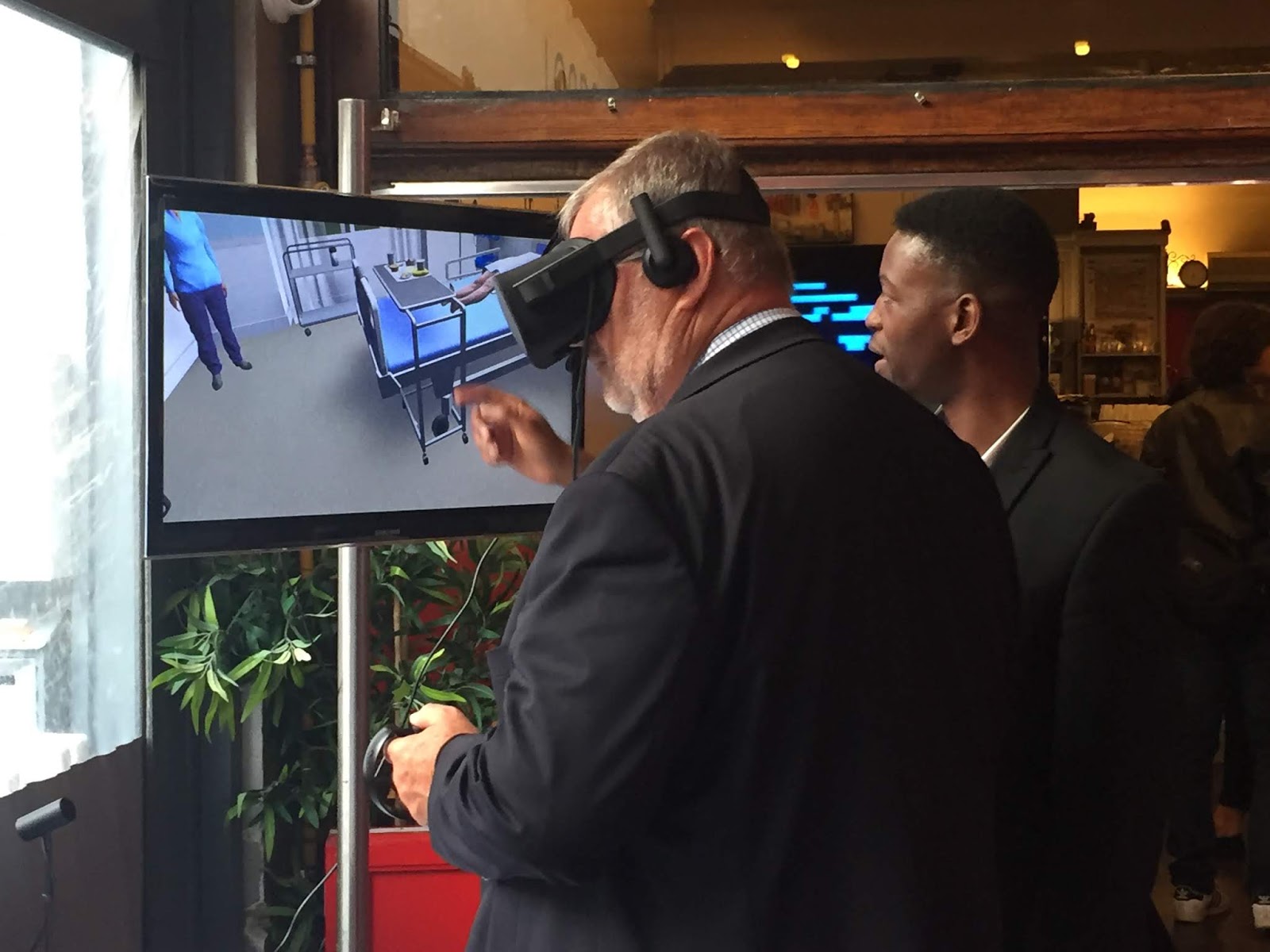
We'd rashly promised that we'd have Trainingscapes working on Oculus Quest for the event and we managed it, just! Denyse (left of picture, with Policy Connect CEO Jonathan Shaw trying the system out) brought BU's shiny new Quest and we brought 2 of our own (and a third turned up at the office today). Space-wise we only had two running in the end, but this is a far cry from the Rift demo's we've been doing as the Quests need minimal set-up, provide a stable environment, lots of good UI (showing real-world imagery whilst you define the guardian space and find the controllers) and all of a sudden VR is easy and you can afford to have multiple people try it at once!

Kneeling down to engage with a virtual 9 year old at eye-level
The content of the main symposium gave some interesting perspectives on technology in schools, FE and HE. Highlights for me were:

  • Excellent chairing by Paralympian Lord Chris Holmes, and highlighting the ongoing need for assisstive technology, and including the best use of Peter Gabriel song (and album) titles ever
  • Paul McKean from JISC providing a great future "day in the life" highlighting the role of tech, and also the fact that most tech mentioned is already in use somewhere (the old Gibson quote about the future is here already, its just not evenly distributed yet). Also some interesting thoughts on micro-credentials (mini/module-level qualifications) and how to aggregate those in the future.
  • Maren Deepwell from ALT talking about how to make users of learning technology into critical users, so that they are aware of potential issues of bias from AI etc
  • Deborah Millar from the Grimsby Institute of FE/HE talkign about their "Level Up" programme to upskill teachers in both LT and productivity and communications tools.
  • Dick Palmer from TEN Group and FELTAG talking about how past visions haven't panned out (must look up the Learning 2020 one he mentioned), and the opportunities for new tech in the land-based industries (didn't have time to show him our virtual cows!)
  • Interesting questions from the floor about personalisation of future LT, and the lack of skills in the current workforce and coming out of institutions in edutech learning design and authoring.


All in all a great day out!


16 May 2019

Virtual Humans Book Launch Report


We had a great (if late) launch for David's Virtual Humans book in Trinity College, Oxford on a lovely sunny Tuesday this week (hence the dark photos in a wood panelled college room!). David gave a brief overview of the history of the book and then there was a fascinating panel discussion chaired by Dame Glenys Stacey (HM Chief Inspector of Probation)(busy week for her!), followed by insightful questions from the floor before we all broke for drinks.

Some brief highlights from the panel session:

Carl Ohman (from Professor Luciano Floridi team at Oxford Internet Institute) spoke about “virtual humans as a new member of the human family” and  problem that there are already too many ethical frameworks for ethical AI ( just like technical standards!).

Sir Anthony Seldon (Vice-Chancellor of The University of Buckingham):

  • talked about AI as being a potentially bigger issue for the future than global warming
  • discussed the idea that humanness/consciousness was the residue once everything else has been transferred to the computer
  • and said that "every Vice Chancellor should get this book” - couldn't agree more!


Dr Elaine Kasket (author of All the Ghosts in the Machine: Illusions of Immortality in the Digital Age) talked about:

  • The After Wife by Cass Hunter and its exploration of the creation of a virtual human as a transitional grief object
  • The difference between passive, one way, digital grief entities (such as Facebook memorial pages) and more interactive or even active types (such as the Digital Immortals discussed in the book)
  • How some people see the commercial opportunities in Digital Grief - "100% of people die, so just think of the market” - talking about the digital grief industry, and questioning the various motivations within it


Dame Glenys Stacey gave a very favourable review of the book and was particularly struck by the 3 challenges identified: humanness (actually the easier one!), general purposeness and sentience - and the books accessibility to the interested lay reader.


Sir Anthony Seldon addressing the audience

Questions from the floor included:

  • Catfishing by digital immortals
  • AI ethical frameworks
  • The lack of chatbot/AI education in schools & FE/HE
  • When do these debates move out of academic/intellectual circles?
  • How the church confessional model relates to our engagement with chatbots and the objectivisation of roles
  • The potential abuse of power and virtual humans by those with malevolent intent, and
  • A Transhumanist perspective on what our lives will be like dealing with virtual humans #AI


Our thanks to all our friends, colleagues and interested readers and researchers who attended.

---

Maggi and David


We've also been sent this review  and photo of the event by Professor Liz Gilchrist ( Academic Head of Psychology, Criminology and the Centre for Violence Prevention (CVP) at the University of Worcester).


Professor Maggi Savin-Baden, School of Education held a book launch and signing of her co-authored book, ‘Virtual Humans’ David Burden, Daden Limited and Maggie Savin-Baden, University of Worcester, published by Taylor & Francis, New York , yesterday at Trinity College Oxford.

The event at the Oxford College included a book signing and a debate across a range of academics interested in various aspects of this area within AI, debating the issue: virtual humans a force for good or evil?

Those involved ranged from those studying chat bots, those interested in posthumous virtual identities, theological considering the implications for definitions of humanness and senior academics considering why academia has not engaged with this topic more fully, given the likely impact virtual humans will have on us in the future. The debate covered ethics, philosophy and educational policy and prompted a great deal of deep thinking.   

David and Maggi’s book was described as  a comprehensive and appealing read and summarised as  explaining the present situation in relation to virtual humans and making a good job of signalling the future, including posing some thought provoking questions.  It is said to be written for the intelligent lay reader – and includes a definition of a virtual human, considers the relationship between virtual humans and artificial intelligence more broadly and highlights 3 big issues around virtual humans improving humanness, contributing to increased intelligence, but questioned whether virtual humans could realise ‘sentience’ and achieve full consciousness.

Sir Anthony Seldon the Vice Chancellor of Buckingham  University commended the book and suggested that all VCs across universities in Britain should have a copy of this book to inform their thinking of where we should looking to move in HE….


2 May 2019

Virtual Humans Launch Event


We're having a somewhat belated launch event for David's book on Virtual Humans on 14th May at Trinity College Oxford, 3pm-5pm.  It will feature a panel discussion on Virtual Humans with Sir Anthony Seldon (Vice-Chancellor of The University of Buckingham), Dr Elaine Kasket (author of All the Ghosts in the Machine: Illusions of Immortality in the Digital Age) and Carl Ohman (from Professor Luciano Floridi team at Oxford Internet Institute). The debate will be chaired by Dame Glenys Stacey (HM Chief Inspector of Probation). Plus drinks and nibbles!

If you'd like to come then please sign up at: https://www.eventbrite.com/e/virtual-humans-book-launch-tickets-57426124083

21 March 2019

Digital Catapult Future of Training Showcase Tour


Back in October last year we were chosen as one of "six immersive companies creating engaging and innovative content to revolutionise the way we train" by the UK Government's Digital Catapult. As well as having a system on permanent display down at heir London Headquarters we've also been invited to take part in a touring showcase of VR in training, alongside local companies in each region. The first event was in London, and the second, last month, in Gateshead. The next one is in Belfast on Tuesday 26th March, so if your in Northern Ireland (or fancy a hop across the border from Eire) then we'd love to see you there. Details at https://www.eventbrite.co.uk/e/the-future-of-training-virtual-augmented-and-mixed-reality-tickets-55902636290


29 November 2018

Immersive and Digital Business Meet-Up - Birmingham


We were delighted to speak at the ImmerseUK Immersive and Digital Business Meet-Up here at Innovation Birmingham Campus this morning. David spoke about our work in using immersive 3D and VR for a wide variety of projects (over 50!) and some of the lessons we've learnt.

Davids slides are here:


Other notable presentations were:


@VirtualSarahJ telling us how's she's getting bored with how boring #VR is and its time for people to go back to Lanier and the 90s and make it a place of dreams - funny, that's pretty much what SL was/is!


KTN warning about the number people who leave competition submissions to the last moment!


Third Skin (@thirdskinhy) talking about their audio AR/biometric wearable.


And old friend @Taran3D talking about using VR to bring a virtual museum on Sikh history to the people.

A good event, with a good turn-out and some useful chats. In particular how to we get the message to HR and Training Directors and C level corporates - that's what is needed to scale this whole thing up.


9 October 2018

World Space Day at The Hive

(photo - Worcester News)

David and Nash took Fieldscapes along to the World Space Day event being held at the Hive in Worcester on the 6th October. This is now the largest free space event in the UK, with over 40 stands covering everything from the Institute of Physics and local Astronomical Societies to Matt Irvin's wonderful TV space and SF models (including the original K9) and bits of Britain's only space rocket - the Blue Arrow.

Jupiter from Io

For the event we created two space experiences - standing on Phobos and seeing Mars, and standing on Io and seeing Jupiter. We chose these as we though the sheer size of each planet hanging above you would give a real "wow" moment, and the two moons have a very different look and feel.

A visitor exploring Phobos with a good view of Mars

We weren't disappointed in the reaction. As people turned and saw the planets (particularly Mars which fills about 1/3rd - 1/2th of your vision) there were audible gasps. Indeed one young user instantly flinched, looked away and refused to look behind her again! Another young VR-naut kept playing peek-a-boo with his parents and loved the fact that with the headset on he was on his own out in outer-space, but when he lifted the headset off his parents were standing right in front of him.


We were in constant demand from opening time til after closing time, and often has a queue of 2 or 3 families waiting. We also had several people come back for multiple goes and to take the time to walk around each moon's surface a bit more.

All in all a great day to educate people about VR and give parents the chance to think about what this might mean for education and training and their jobs.

The star attraction for many people of a certain age!


We'll post the environments up onto Fieldscapes so that anyone can give them a try.


10 September 2018

Trainingscapes at the EU40 BBQ


MedtechEurope CEO Serge Bernasconi tries out Trainingscapes

David and Nash headed over to Brussels last week at the invite of MedTechEurope which was sponsoring the annual EU40 BBQ and wanted to show MEPs how innovative technology such as VR is being applied in the medical and health arena.

EU40 is the platform of young Members of the European Parliament and of the 28 EU national parliaments. Their mission is to serve young Members under the age of 40 and strengthen their role inside the European Parliament by adding aesthetics, fun and fresh ideas to European politics!


MedtechEurope started as an alliance in October 2012 formed by two organisations - EDMA, representing the European in vitro diagnostic industry; and Eucomed, representing the European medical devices industry. MedTech Europe engages with EU regulators, politicians and other decision-makers to help shape policies to promote innovation for our growing healthcare needs and expectations. Its aim is to encourage policies that help the medical technology industry meet Europe’s growing healthcare needs and expectations. It also promotes medical technology’s value for Europe focusing on innovation and stakeholder relations, using economic research and data, communications, industry events and training sessions. MedTech Europe’s mission is to make innovative medical technology available to more people, while helping healthcare systems move towards a sustainable path.


Despite the torrential rain during set-up we had a great time letting attendees work through a version of the Diabetes training application that we've just done for Bournemouth University. We also had the same app running on an iPAD to show that VR headsets aren't mandatory. We also had some pharma data in 3D on Datascape running on Google cardboard to show another use of the VR technology.


All in all a great evening, and our thanks to MedTechEurope for inviting us.


3 September 2018

Fieldscapes is off to the West Midlands BIS Space Day


In support of World Space Week Daden is taking Fieldscapes to the British Interplanetary Society (BIS) West Midlands Space Day in Worcester on 6 Oct. We'll have our existing Apollo 11, Mars Exploration and Solar System experiences and hopefully a few new ones.

Details at https://www.bis-space.com/2018/01/16/20116/space-day-2018 and https://www.facebook.com/events/657550341300272/?active_tab=discussion.


Hopefully see you there!

4 October 2017

Fieldscapes at the Malvern Festival of Innovation

Oculus Rift on the Moon

For the second year in a row we ran a set of workshops at the Malvern Festival of Innovation playing host to a succession of groups of 20-30 students (mostly year 7s) from around Worcestershire and giving them a 1 hour introduction to immersive learning. We set up four stands in order to show the range of experiences and lessons that can be created, and the different ways in which they can be delivered. We had:


  • One laptop running the Solar System lesson
  • One laptop running the Apollo Educate lesson
  • One laptop running the Introduction to Carding Mill (which several groups knew from Fieldtrips)
  • A couple of Google Cardboards, one with the Photosphere tour of Carding Mill and one the Apollo Explore lesson
  • Oculus Rift running Apollo Explore
Playing tag on the Moon!


Students were split into groups of about 5 and had 10 minutes on each "stand" - so everyone got to try all the kit.

Looking at the Waterspout Waterfall in a (plastic) Google Cardboard


Student feedback from comments and feedback forms included:
  • "I wish I could spend all afternoon here"
  • "Can I come back later?"
  • "It was really cool"
  • "It was fun to do"
  • "It was memorable"
  • "The realness of it"
  • "I liked the fact that we were not there but we could see everything"
  • "It was like it was real"
  • "It was educating and fun"
Exploring the Moon and Apollo on Google Cardboard


When talking to the teacher we were keen to highlight that:
  • They didn't have to buy any new hardware, like expensive VR headsets, as they can run lessons in 2D/3D mode on existing computers, or in VR on Google Cardboard (one teacher loaded the app onto his phone as we spoke)
  • They could create their own lessons, share them, and use (and customise) those producted by other users
  • With our licencing model they only started paying once they started using it in class, so they could explore and test for free until they were confident in the system and lessons and were ready to use it in class.
Even the teachers got in on the act!


Fieldscapes itself was rock solid on all the devices all day - despite getting a hammering from the kids. What was particularly impressive was when we had the Apollo experiences in multi-user mode so the kids could play tag on the moon - and even using the public wifi at the venue we had no issues with lag and avatar movement was very smooth.


All in all a great day and helped remind us all why we've built Fieldscapes!


15 September 2017

AI & Robotics: The Main Event 2017


David spoke at the AI & Robotics: The Main Event 2017 conference yesterday. The main emphasis was far more on AI (well machine learning) rather than robotics. David talked delegates through the AI Landscape model before talking about the use of chatbots/virtual characters/AI within the organisation in roles such as teaching, training, simulation, mentoring and knowledge capture and access.

Other highlights from the day included:


  • Prof. Noel Sharkey talking about responsible robotics and his survey on robots and sex
  • Stephen Metcalfe MP and co-chair of the All Party Parliamentary Group on AI talking about the APPG and Government role
  • Prof. Philip Bond talking about the Government's Council for Science and Technology and its role in promoting investment in AI (apparently there's a lot of it coming!)
  • Pete Trainor from BIMA talking about using chatbots to help avoid male suicides by providing SU, a reflective companion - https://www.bima.co.uk/en/Article/05-May-2017/Meet-SU
  • Chris Ezekial from Creative Virtual talking about their success with virtual customer service agents (Chris and I were around for the first chatbot boom!)
  • Intelligent Assistants showing the 2nd highest growth in interest from major brands in terms of engagement technologies
  • Enterprise chat market worth $1.9bn
  • 85% of enterprise customer engagement to be without human contact by 2020
  • 30% increase in virtual agent use (forecast or historic, timescale - not clear!)
  • 69% of consumers reported that they would choose to interact with a chatbot before a human because they wanted instant answers!
There was also a nice 2x2 matrix (below) looking at new/existing jobs and human/machine workers. 


This chimed nicely with a slide by another presenter which showed how as automation comes in workers initially resist, then accept, then as it takes their job over say the job wasn't worth doing and that they've now found a better one - til that starts to be automated. In a coffee chat we were wondering where all the people from the typing pools went when PCs came in. Our guess is that they went (notionally) to call centres - and guess where automation is now striking! Where will they go next?

17 May 2017

VR World Report

I spent the last couple of days at VR World down in London. The event was busy pretty much the whole time and the 3 open lecture areas had a good mix of talks and discussions. There were also a good number of exhibitors showing  a range of AR/VR apps and kit, although nothing that really blew me away.

Photo report below, but main takeaways were:

  • Almost more AR/MR (Hololens) than VR
  • Far more Vive than Oculus (can understand that from a developer's perspective)
  • A few Cardboard based apps
  • Nobody showing Gear VR - whereas previous events I've been to have been full of them
  • A few haptic input devices, but no-one showing gloves
  • Still a lot of 360 video/photosphere stuff
  • Does stringing together a set of other peoples VR videos count as a presentation?
  • Some people had really been drinking the VR Kool-Aid with the "this will change the world by 2020" type speeches and stats - it won't, it's just another tool
  • Very few people showing analysis frameworks of how this all fits together
  • A few people showing some good evaluation stats, even more calling out for everyone to share them - been calling for that for ages
  • Nobody really doing data visualisation
  • Just one company doing authoring - and more a Unity-light approach for simple photosphere menus
  • More doing training then education

Now the photos:

How VR can fill the gap in medical training

Some nice promo type work from JauntVR


And some nice stats about impact

Nice guidelines on MR (and VR) development from Viscopic

Some great data from Touch Surgery - and this was 3D not VR surgery training - surgeons did better than trainees - so valid

The learning effect - with repetition people got better

Proper control group testing

More improvement in the group using the 3D trainer

A touch interface - but one interface too many on the demo rig?

A physical labyrinth explored with Vive and backpack PC

Fracture showing some nice Hololens demos of city data - see below

Affordable and easily integratable slippery feet walk controller - may well integrate with Fieldscapes 
Hollywood production values in Rolls Royce robot ship control demo


Very neat though - and no-one wearing any headsets!

Better view of Fracture in the TfL demo - see next blog post