23 September 2019

We're on the Midland's Innovation 50 Index!


We're pleased to announce that we've been listed on the Innovation 50 - a report ranking 50 of the Midlands’ most innovative businesses. The report has been published today by Midlands law firm Mills & Reeve as part of its biennial “Innovation 50” – a campaign that celebrates the region’s R&D royalty, industry groundbreakers and rising stars.

The report, compiled by Mills & Reeve, highlights innovative success stories from across the region and features 50 businesses across five categories: Business intelligence and performance; Communication; Development and inclusivity; Healthier, safer lives and Place and environment.

 The panel judged entrants on both their originality and impact, with the 50 highest-scoring businesses securing their place in the report. 

Steve Allen, Head of the Birmingham office at Mills & Reeve, said:

“Innovation is at the heart of what we do at Mills & Reeve. From pushing boundaries in our own products and services – earning us a place in the 2019 FT Innovative Lawyers Top 50 and wins at the Legal Week Innovation Awards – to celebrating those that are making waves in their markets, we’re on a mission to encourage and recognise forward-thinking business activity that solves problems. 

“We launched the Innovation 50 in 2017 to celebrate Midlands businesses at their most enterprising, confident and creative. Two years on, and the buzz around the region has only grown – with the quality of 2019 entries showing that we more than live up to our national reputation. From social enterprise to telecoms and business support to agritech, the 2019 Innovation 50 is leading the way with fresh ideas and standout execution. We’re proud to launch the latest report, and look forward to seeing the journeys that these businesses take in the coming years.”

Daden submitted both our work on immersive 3D and virtual reality training with Trainingscapes, and our work around virtual life coaches and mentors.

You can see who else is in the Innovation 50 by downloading the report from file:///Z:/marketing/!Corporate/PR&Media/2019/Innovation50/Mills&Reeve-Innovation50-2019reportFFV.pdf


New Infographic on VR vs Physical Learning and eLearning


Here's a new infographic from us about why you should use immersive 3D and virtual reality in comparison to physical training or conventional eLearning. Of course the bottom line is that all forms are valid - but you need to know the advantages and disadvantages of each in order to develop an appropriate blended training and education programme.

Download as PDF.


16 September 2019

New Trainingscapes Video


View on YouTube.

We've got a new video out to explain the problems with current training methods and how immersive 3D and virtual reality training, and of course Trainingscapes, can help address them as part of a blended training solution.

If you'd like a demo of Trainingscapes just get in touch by email to demo@daden.co.uk.

9 September 2019

Is VR for Training finally ready for Prime-Time?


It’s 6 years since the first Oculus Virtual Reality headset hit the streets. Since then VR has struggled to build a user base but is that now about to change?


The Hardware...


The first Oculus Rift headset was a revelation, VR was finally accessible. But the Rift, and the similar HTC Vive headsets, suffered from four big problems:


  • They needed expensive PCs to drive them
  • They needed external sensors to be set up in order to track lateral and hand movement
  • Each installation could be slightly different, making it hard to deliver a solid, replicable experience
  • Once you had your headset on it was hard to find the controllers and stay safely in your space


With the Oculus Quest it looks all of these problems have been solved:


  • The headsets work completely standalone – so no expensive PC and also a dependable platform for a consistent experience
  • There are no external sensors, the headset just uses the environment to track user head and hand controller movement
  • There is a look-through video mode so you can see to pick up controllers, and see around you when you leave the “safe zone” 


All of these combine to create the easiest and most fluid VR experience we’ve ever had!


The Software...


But hardware is nothing without good software.

Teachers, trainers and tutors have had a long history of creating their own content, from drawing on chalk boards and white boards, through Letraset on OHP slides and Roneo’d handouts, to the near ubiquity of Powerpoint.

3D and VR though has long been seen as a specialist area, where niche design agencies are commissioned to create bespoke content. But this costs, and the use of third parties means (like video) that it is hard to update content and to keep it current and tailored to specific classes.

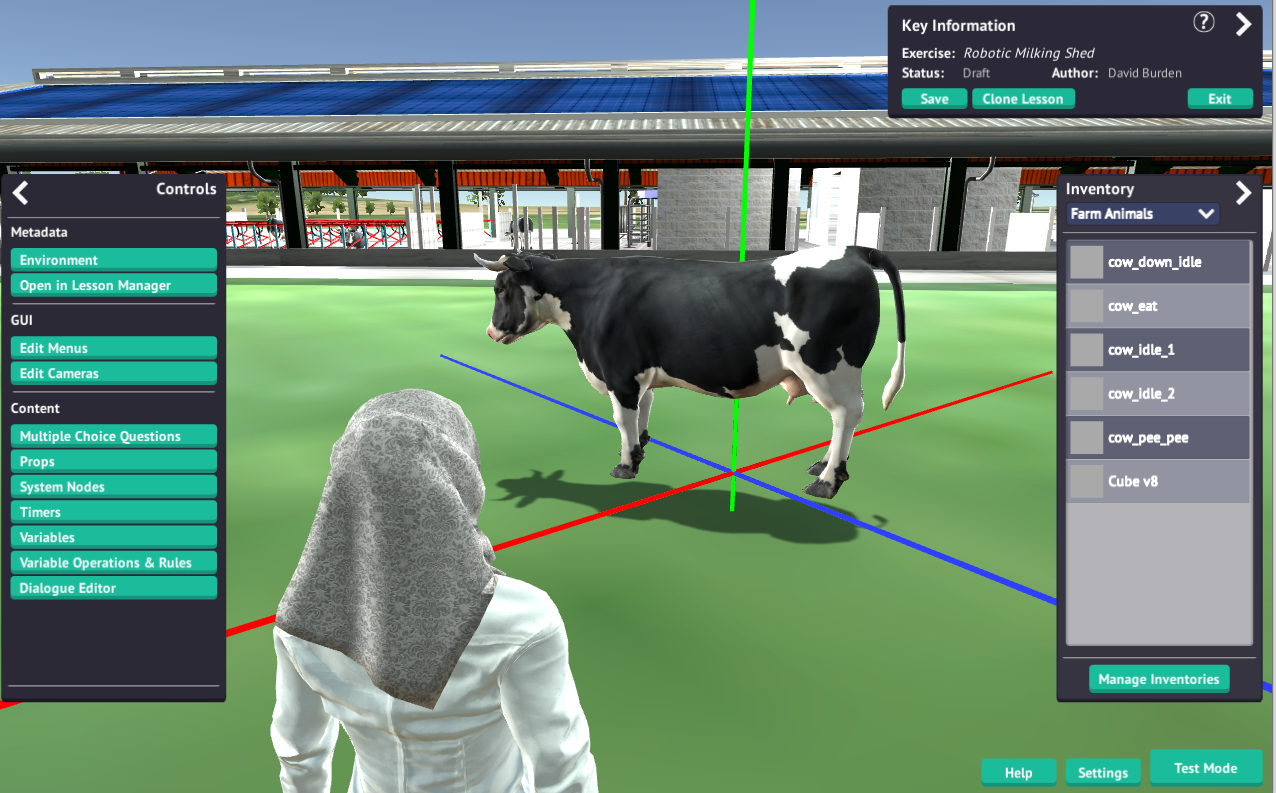
With Trainingscapes Daden is changing that. Trainingscapes is an authoring tool for immersive and 3D content which lets tutors create their own lessons from almost any PC/Mac, even when on the train, and then deliver them to students without any need to write code or to have a deep understanding of 3D. A simple drag-and-drop, what-you-see-is-what-you-get experience makes creating VR as easy we can make it.

Whilst VR is more usable and affordable than ever we recognise that it won’t suit everyone, or every task, or every location. So it’s also important that your investment in 3D isn’t constrained to VR devices. With Trainingscapes trainees and students can access the same learning from any PC, Mac, Android or iOS device (as well as VR) getting much of the benefit of VR without the hassle. And we’re even looking at how we can extend immersive 3D and VR to visually impaired users.

So with hardware, content and accessibility all coming together, we feel that VR for training is finally ready for prime-time.

Isn’t it time that you gave it a try?

For a demonstration, or more information on Trainingscapes and how immersive 3D and Virtual Reality can help train your employees, trainees and students, contact us on 0121 250 5678 or email info@trainingscapesvr.com or check out our website at www.trainingscapesvr.com.


2 September 2019

Amazon launches Prime Video virtual reality stream


The Amazon Prime Video VR platform has been launched, giving subscribers of this service the chance to enjoy some of Amazon’s streaming content via a more immersive experience.

Prime subscribers who are interested in using the new virtual reality service will no doubt be pleased to learn that the immersive content can be viewed using a variety of VR headsets on the markets. Among these include the Oculus Quest, Oculus Go, Oculus Rift and Samsung Gear VR.

The Amazon Prime Video VR platform can be accessed by an app and requires one of the above listed headsets. According to Amazon, the VR headsets can be used to watch “Amazon originals, channel subscriptions, live events and more.”
Additionally, the service has also been designed to allow users to search for content using their voice. The voice search feature allows Prime streamers to quickly find titles or whole categories.

To get the service up and running, a prime member will need to pair one of the compatible headsets with the free Prime Video app. For instance, in the case of Oculus, a user would simply pair their headset with the Oculus mobile app, navigate to the Oculus store on the headset and find the Prime Video app. They then need to download and install the app, launch it and sign in with their existing Amazon account to gain access to the virtual reality feature.

Presently, The Marvelous Mrs. Maisel, Guava Island, Good Omens, Catastrophe, Fleabag, The Grand Tour, Carnival Row, The Man in the High Castle, Tom Clancy’s Jack Ryan and Bosch are VR ready, according to Amazon. The company also said that it intends to expand its VR-capable library.

While Amazon customers do not require Prime subscription to watch videos in their personal library, they will need a subscription and the VR app if they wish to access the virtual reality Content. Also, the Amazon Prime Video VR app is currently available for only customers in the US and UK. 

29 August 2019

How VR can help adapt treatment to mental health conditions, potentially saving the NHS money and freeing-up therapists.


Confronting fears in virtual reality could be the future of therapy after a trial by Oxford academics found nearly 3 out of 4 patients with a serious phobia of heights could overcome it, reports the Independent.
In the study a virtual reality coach guided them around a 10-storey building with a large open atrium in the centre, gradually encouraging them to lean over the edge to rescue a cat or cross a rope bridge. Volunteers who had struggled to approach balconies or take escalators for decades had their irrational concerns banished in a matter of hours, without any input from a human therapist.

“In day-to-day life I’m much less averse to edges, and steps, and heights,” one of the trial’s participants said afterwards. “When I’ve always got anxious about an edge I could feel the adrenaline in my legs that fight/flight thing; that’s not happening as much now…I feel as if I’m making enormous progress, and feel very happy with what I’ve gained.” After his treatment, Dick, a retired paramedic whose severe fear has bothered him his entire life was able to relax looking over a shopping centre balcony, something he said “would have been impossible before”.
Acrophobia, the fear of heights, is the most commonly reported phobia with one in five people saying they have some aversion and 5 per cent of the population being clinically diagnosed.
The study recruited 100 volunteers with a formal diagnosis who had had their fear for around 30 years on average. Half of the volunteers (49) were randomly allocated to the VR group although two were unable to complete the therapy because it was too difficult for them.
In six 30-minute sessions with the headsets over two weeks they began with a VR-coach character asking them to explain what caused their fear: whether they were worried they would fall or throw themselves off the building for example, and explaining basic psychology of the condition.

They then entered the virtual building and at each of the ten floors performed tasks, starting with standing near the edge while a safety barrier moved away or dropping a ball. It then progresses to more challenging problems, such as crossing the expanse on a bridge.
After treatment 34 of the 49 participants (69%) were no longer classed as clinically phobic.
This is the first trial to show the benefits of VR-therapy on its own and the team from the University of Oxford say it could be applied to other mental health conditions and help address a critical shortage of doctors in this area.
“As seen in our clinical trial, virtual reality treatments have the potential to be effective, and faster and more appealing for many patients than traditional face-to-face therapies.” They also have the potential to be much more cost effective. While the initial scheme required months of work from programmers, actors and therapists to fine tune, the equipment is available cheaply and can be replicated widely.
Dr Mark Hayward, of the University of Sussex, said the findings were “very promising” for virtual reality, but added that in more serious mental health disorders like psychosis, these treatments still require a professional therapist’s involvement.

Source: https://www.independent.co.uk/news/health/virtual-reality-phobia-fear-heights-mental-health-treatment-oxford-university-lancet-a8442696.html


27 August 2019

Can virtual reality improve your sleep?


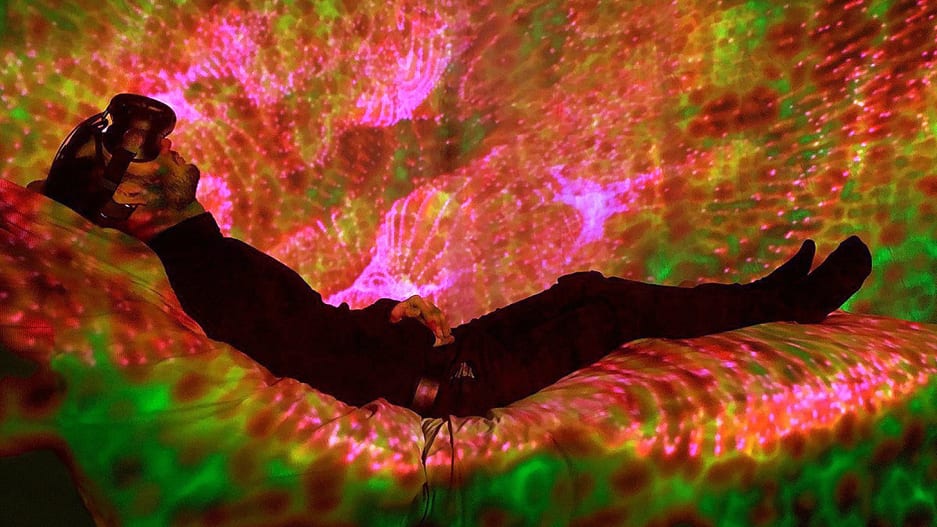
[Image: courtesy RMIT University]

People who sleep well go to bed calm, while those who don’t lie in bed anxious. But as anyone who has trouble sleeping knows, you can’t always just tell your racing brain to relax and forget about that student loan debt until tomorrow morning. So sleeping poorly can be a self-reinforced cycle. People go to bed anxious because they don’t sleep well. And they don’t sleep well because they go to bed anxious.

New research reported by Fast Company from the Exertion Games Lab at Royal Melbourne Institute of Technology University has found that there may be a simple solution for some people who have trouble going to sleep: giving them a chance to look at their own brains as they lie in bed.
Scientists invited 12 healthy students into their lab and placed an EEG monitor—or a device that measures electrical brain activity—on their heads. The students laid down and were fitted with a VR headset that contained an artistically interpreted visualization of those brainwaves. The more excited the person’s brain was, the more active the visualization would be, with greater contrast, color, and amplitude.
What researchers found was that after 10 minutes, subjects reported a significant drop in what’s called “pre-sleep cognitive arousal.” That means their minds were quieter and in the state we know leads to good sleep.
While the study didn’t have the subject pool or control groups necessary to be entirely certain that it was the brain visualization, and not just any old visualization, that made the difference, researcher Nathan Semertzidis tells us that findings suggest “the feedback loop” between the sleeper, the visualization, and their brain “is core to the experience.”

As one subject put it in a post-study interview, the visualization was like a tool to relax: “I was drifting off to worries, mainly about work, and [the change in visuals] brought me out of that.”

“The mechanisms which the neurofeedback element of the system operates on is closely aligned with mindfulness meditation,” says Semertzidis, since this system kept people in the moment to avoid rumination and created a sense of calm just as meditation does. “Considering this, it would be possible to achieve similar benefits by performing mindfulness meditation before sleep to move the mind away from focusing on stressors which might otherwise hinder your ability to sleep. However, the downside to this is that mindfulness meditation requires a lot of practice before its benefits can be properly felt.”

Source: https://www.fastcompany.com/90381066/scientists-discover-a-counterintuitive-trick-to-falling-asleep-faster