11 May 2020

The "New Normal" - an Opportunity for 3D/VR Immersive Learning


For the HE/FE and training sector I am sure that the last month or so has been about coping with rapid changes needed to deliver the summer term's learning on-line, and that most of this has been focused around VLEs, Zoom and the like.

However as it increasingly seems that the "new normal" will impact teaching and learning for probably at least a year, to what extent will FE and HE institutions and commercial training organisations take the opportunity to have a fresh look at immersive 3D and VR solutions. Whilst VLEs, video lectures and Zoom tutorials can deliver a lot of useful content, they will struggle with the sense and context of being there, of learning vocational skills, and of working on physical collaborative tasks. Physical teaching time may be even more limited, and social distancing measures may further reduce the effectiveness.

Of course institutions (and other organisations) are likely to be feeling real impact on budgets, particularly for HE from reduced numbers of overseas students, and possibly even of UK students, and the media are reporting of costs of £1-2m per degree to move to distance learning. And in these stressful times it may be that IT departments, eLearning teams and tutors just fallback on the comfort of familiar (if not totally prevalent) technologies of video lectures and lessons/seminars by video conferencing.

Having been involved in using immersive 3D (and lately VR) for training and education for over a decade it does very feel like a technology whose time has come. We are already seeing an increase in the use of the technology for virtual events (where there is no need to generate content as such), and using it for remote training and learning is surely the next step. That said, the focus may well be on the "immersive 3D" aspect rather than VR unless institutions want to pay for a headset per student - the days of sharing may well be over! Also our key argument remains that you need to be able to create your own content so you can adapt to student need - rather than commissioning "one-offs" from design led VR agencies.

As we at Daden get ready to launch Trainingscapes 2.0 (the updated version of our Fieldcapes application) we feel that Trainingscapes is uniquely positioned to help deliver 3D immersive learning within the "new normal", in particular:

  • It is not a VR only, or even VR led, tool, and is happy supporting uses on smartphones, tablets, laptops and PCs, as well as those lucky enough to have (home) access to a VR headset
  • It has an intuitive content authoring system so that eLearning teams, tutors and even students can create their own 3D/VR content - so you can iterate and scale quickly and at low cost


We're trying to get a feel from those we know working at the "coal face" of education in HE and FE as to how they see the next year panning out - and to what extent they see immersive 3D and VR solutions as being a part of the "new normal"  mix, and we'll see about passing on some of feedback we get. But we're always interested in the wider view - so if you're readin gthis then please feel free to add your view in the comments.

These are interesting, challenging and distressing times, but perhaps a richer educational and training environment can be one of the legacies.


8 May 2020

DadenU Day: The Design of Everyday Things

For Krish's DadenU day the other week Krish looked at Don Norman's influential book, The Design of Everyday Things.


If you have ever pulled a door instead of pushing it, if you have ever been unable to figure out how your microwave works beyond its basic functions and you struggle with those too, and if you get frustrated with software because you cannot get it to do what you want it to do then you are certainly not alone. These experiences can often leave you feeling a little stupid and give the impression that it is your fault for not using things correctly.

Don Norman, in his book, The Design of Everyday Things, would argue that it is not your fault and you should not be the one feeling stupid. He goes on to say that it is the fault of the designer for failing to design for humans. Originally the book was named The Psychology of Everyday Things because it was challenging designers to think about human psychology or the way humans think and behave in their everyday interactions with everyday things. If designers could understand this, they would make better designed products to account for this human behaviour.

Don Norman thinks that design should go beyond finding the solution to a problem although this is a good starting point. Designers, engineers and software developers need to take into account that our thought is very much guided by our emotions rather than being rational. Emotions allow us to make value judgements, help us prioritise what is important and give us the ability to think intuitively as well. These emotional thoughts may be visceral which means they provoke strong feelings within us; they may be behavioural which means that we react positively, more often than not, to the familiar and less positively to the unfamiliar, and finally our emotional thoughts can be reflective which means we look back on past experiences, good and bad, which inform our choice, but we also have the insight to look at future possibilities.

So a successful product not only has to function correctly to solve a problem, but we must consider how we can make a product or design software that evokes positive emotions so that users enjoy the product, so that there is enough familiarity built in to make them feel safe and know how to use it intuitively, and finally it should evoke reflective emotions that are positive.

Don Norman would be the first  to admit that this challenge is not easy to respond to otherwise we would all be making amazing products. However Don Norman does suggest that we should spend more time observing people doing the things that they do with the tools that they use. We may find that often the problems that people have are not the root problem but a symptomatic problem due to poorly designed systems and tools. Spending time in observation may help us as designers to get a better insight into the root problem. It will also give us more insight into the way people behave providing us with the information we need to design better products. Designing for user experience is therefore a research based discipline at its heart.

Although Don Norman’s book is now more than thirty years old, the principles it outlines are far from out of date. Some of the best products in the world follow the principles outlined in his book.

17 March 2020

Virtual Avebury: exploring sense of place in a virtual archaeology simulation - now In Press


The academic paper on our Virtual Avebury project with the National Trust and Bournemouth University is now "in press" at the Virtual Archaeology Review.

You can read the PDF at Virtual Avebury: exploring sense of place in a virtual archaeology simulation


8 November 2019

Virtual Reality Wargaming


A good day yesterday at Coventry's Manufacturing Technology Centre where Dstl were holding a show-and-tell on Defence Wargaming. We were luck enough to get a demo and a talking slot.

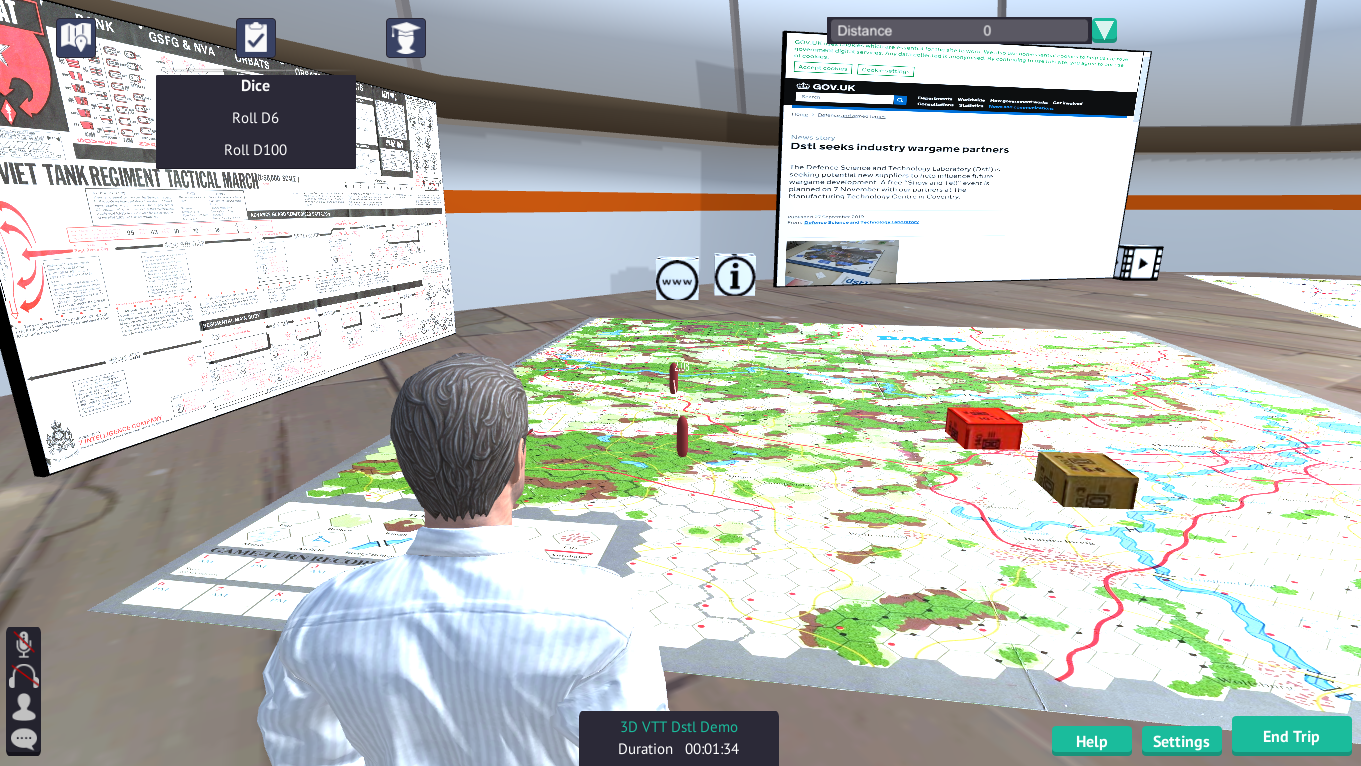
For the occasion David updated the Virtual Wargames Room (our 3D Virtual Tabletop - 3D VTT) we built in Trainingscapes a year or so ago. The new version was optimised for the Oculus Quest (which meant the hex board and model soldiers had to go).


Within the space we have:

  • Three big floor maps for wargames, BAOR 1984 (an old SP game), Waterloo and the Modern War's Crisis in the Baltic. These have a real sense of scale, the BAOR map in particular looks like it's filling a whole sports hall and you just want to walk all over it!
  • Example counters (done as cubes for ease of handling) for each game
  • A more conventional "wargames table", in this case with a hex grid and some example troop blocks and terrain features, and even an example simple 3D sculpt tank and figure (think Airfix 1/32nd!)
  • A dice for random number generation
  • Some static information panels (one on Soviet tactics, the other a ruleset aide-memoire)
  • A couple of dynamic information panels/web browsers to bring in rule or period related data or even live Google Docs so you can log (or read) activity and someone on the web can read/update it.

One of the whole aims was to keep it very simple. Nothing is automated, it works just the same way as though you got a physical wargame out on a real table (and we even had people knocking things off the table as in real life, and picking them up to keep the place tidy afterwards).

A visitor moving virtual pieces on a virtual wargames table!
That simplicity really worked and we got a great response to the whole concept. We also got some great feedback to our lightening talk, linked both to current projects we have with MOD and some of the peripheral (e.g. the BattlefieldAR system we are working up with Battlefields Trust) and hobby projects we are working on.

The whole day gave a good insight into some of the companies working in the professional wargaming space (or with aspirations to work there), running the whole gamut from machine-learning AI based systems to good old paper and card wargames and PIP dice for unit activation. There was also a good presentation on the current MOD needs in this area, so hopefully we'll get the chance to progress some of the ideas we presented a bit further.


25 October 2019

Daden's MOD DASA VLC Project featured on Gov.UK News Page


Nice to see our Virtual Life Coach project featured alongside the other Phase 2 funded Defence People projects in a piece from MOD on the Gov.uk web site.

Nearly £1m is being invested to further develop and trial cutting-edge artificial intelligence, psychological, and neuroscience tools and technology such as brain scanners in a bid to boost the training, wellbeing, and mental health support offered to personnel.

Minister for Defence People and Veterans Johnny Mercer said:

"We welcome this £1m investment from DASA aimed at improving the welfare of Armed Forces personnel."
"Our Armed Forces serve this country to an exceptional standard and help to keep us safe, so it’s only right that they receive the best possible training and support."

Chief of Defence People Lieutenant General Richard Nugee said:

"Defence innovation is about more than just the kit our Armed Forces use. It’s also about our men and women who serve our country."
"This £1m investment will see seven projects developed from improving training methods to boosting the pastoral care and mental health support we offer our people."

The funding is part of the second phase of DASA’s Defence People Innovation Challenge funded by the Defence Innovation Fund which is managed by the MOD’s Defence Innovation Unit; and sponsored by MOD’s Chief of Defence People.

Daden Ltd has been awarded around £150,000 to pilot a virtual life coach which can help with day-to-day personal, employment, and career issues with an aim to maintain motivation and supporting retention. The system will also track satisfaction, stress and help personnel set long-term personal and career goals. The system will be trialled at RAF Fylingdales.

Dr Adam Staines, DASA Competition lead, said:

"DASA is working with businesses of all shapes and sizes and academia to find and fund the latest innovations to benefit UK defence and security."
"Building on the successful first phase of this competition we are continuing to mesh cognitive science, artificial intelligence (AI) and the latest technologies to develop tools to support MOD personnel across their working lives."


Full article at: https://www.gov.uk/government/news/1m-innovation-boost-for-service-personnels-welfare-and-training

7 October 2019

New: Immersive 3D and VR Training and Learning White Paper


An updated 2019 edition of our Immersive Environments for Training, Education and Learning White Paper has just been released, describing how immersive 3D and Virtual Reality can be used to train and educate. The 28 page paper presents some of the academic models which we use to help support the design process, considers some of the key design decisions, identifies the benefits of 3D/VR over physical training and eLearning (whilst accepting that a blended approach is probably the goal), and describes a variety of uses cases by Daden and others to show how immersive training can be used and its efficacy.

You can download a copy FOR FREE (and no sign-up required) at https://www.daden.co.uk/resources - just scroll down to the White Papers section.

BTW - the first version of this paper came out in 2014!


World Space Day at Worcester


We spent Saturday down at the Hive in Worcester for the second year exhibiting at the World Space Day event - apparently the biggest free one in the UK.

We had two Oculus Quests (plus a spare) and managed to screencast from one to a monitor, but the wifi was too ropey to get multi-user working. We had two experiences: standing and exploring on Io whilst looking at Jupiter, and standing and exploring on Phobos whilst looking at Mars.


Both headsets were active non-stop from 10am to 4pm, we didn't even get lunch and had people coming round again for a 2nd go by the end. Lots of great comments from people about how much they enjoyed the experience, and lots of parents taking photos and videos as their kids explored VR and got excited by space.


And it just so happened that the only other people there with a VR headset were RAF Fylingdales, or trials partner on an MOD project!