28 September 2018

Centre-Phi VR Exhibition

Whilst in Montreal I was lucky enough to spend a couple of hours at the newly opened  Echo VR Exhibition at the Centre-Phi in Old Montreal. This show had 12 different VR exhibits, all on the arty/edutainment rather than game side, on a mix of Oculus Rift, Oculus Go and Gear VR headsets.

Whilst a few were 360 (or even 180) degree video, the rest were fully immersive, usually with room scale tracking, or in rotating chairs. Most were around 15 mins, some as short as 4 mins, others as long as 30 minutes.

The most interesting were:


  • Spheres - a set of 3 VR experience about space. All pretty trip and following an "everything is better with tilt-brush" meme. Batting planets was fun - and interesting that if you bat then the wrong way the'd eventually slow and orbit in the correct direction. The huge planet encounters were fun, but what was interesting was since you had no sense of self you had no sense of scale - there were just big balls! It will be interesting to see if we can get a different experience with our World Space Day experiences - more later. See http://www.elizamcnitt.com/spheres/


  • Tales of Wedding Rings - A Japanese combination of manga and anime, all in black and white and very realistic animation (mo-cap, even rotoscope looking). For much of the experience the cartoon/manga frame was in front of your against a black background and you looked through this frame onto the 3D manga still frame or anime scene. You could peer in and round, so it was full 3D. Then for some scenes the frame could come forward and engulf you so that now you were in the full 3D itself with the action taking place in front of you - but with the option of looking all around at the beautifully crafted scenery. The female character was a bit BESM manga style, but technically it was a great looking piece and an interesting possible direction for manga/anime/graphic novel/BD VR. Buy for Oculus at https://www.oculus.com/experiences/rift/1681506908561513/ (and video trailer)


  • Wolves in the Walls - A young girl alone in an attic bedroom can hear wolves in the wall - can you help her? This piece, based on a book by Neil Gaiman,  probably had the best realised virtual character I've seen so far in VR. As you follow her around the small room, crouch down to talk to her or look at what she's drawn it really does feel like your in the room with her. The most notable feature was that when she speaks she always looks at you - no matter where you are standing - I kept try to move to catch her out but never did - awesome response to the headset tracking! It's interesting that Fable, the studio behind this, has kicked off a whole "Lucy Project" to create a character that is interactive and believable. In many ways Lucy is the closest thing I've seen yet to the old Milo "smoke and mirrors" demo from Lionheart - and of course all the more possible because it has digitised the human so everyone is in the same virtual space. You can read more about Wolves in the Walls at https://fable-studio.com/wolves-in-the-walls/ and https://www.oculus.com/blog/vr-visionaries-fable-studio/.


Whilst the video versions wont give you the VR experience they'll give you a sense of what they are doing, and hopefully we'll see some of these multi-VR showcases at arts centres in the UK.

10 September 2018

Trainingscapes at the EU40 BBQ


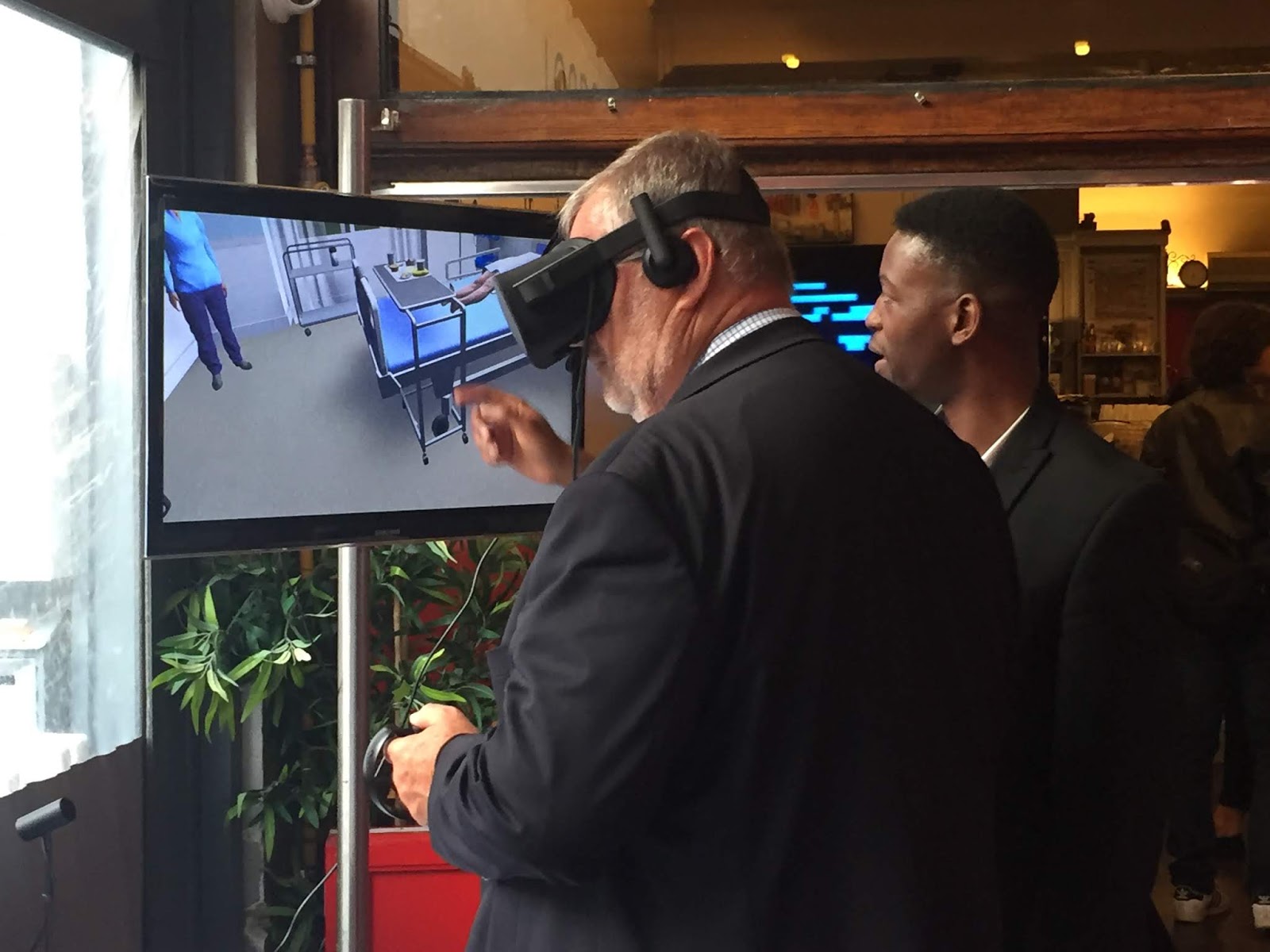
MedtechEurope CEO Serge Bernasconi tries out Trainingscapes

David and Nash headed over to Brussels last week at the invite of MedTechEurope which was sponsoring the annual EU40 BBQ and wanted to show MEPs how innovative technology such as VR is being applied in the medical and health arena.

EU40 is the platform of young Members of the European Parliament and of the 28 EU national parliaments. Their mission is to serve young Members under the age of 40 and strengthen their role inside the European Parliament by adding aesthetics, fun and fresh ideas to European politics!


MedtechEurope started as an alliance in October 2012 formed by two organisations - EDMA, representing the European in vitro diagnostic industry; and Eucomed, representing the European medical devices industry. MedTech Europe engages with EU regulators, politicians and other decision-makers to help shape policies to promote innovation for our growing healthcare needs and expectations. Its aim is to encourage policies that help the medical technology industry meet Europe’s growing healthcare needs and expectations. It also promotes medical technology’s value for Europe focusing on innovation and stakeholder relations, using economic research and data, communications, industry events and training sessions. MedTech Europe’s mission is to make innovative medical technology available to more people, while helping healthcare systems move towards a sustainable path.


Despite the torrential rain during set-up we had a great time letting attendees work through a version of the Diabetes training application that we've just done for Bournemouth University. We also had the same app running on an iPAD to show that VR headsets aren't mandatory. We also had some pharma data in 3D on Datascape running on Google cardboard to show another use of the VR technology.


All in all a great evening, and our thanks to MedTechEurope for inviting us.


5 September 2018

Virtual Avebury drawing to a close


(image posted on Facebook - https://www.facebook.com/photo.php?fbid=10213810222462658&set=p.10213810222462658&type=3&theater by Brett Cullen)


The run of Virtual Avebury has now come to an end, although we are doing a bit of direct remote public access to the VR experience - more details to follow.

There have been over 100,000 views of the video of Avebury in Fieldscapes on the National Trust Avebury Facebook page, and well over 500 physical users of the VR experience on site, and even some fan-art!


There were two VR rigs on-site so users could go in and see each other and follow each other round. The kids visit with their parents during the school holidays just loved this, playing virtual tag between the stones. And then whey they discovered that you could fly as well!

Liz and the team from Bournemouth University are now writing the project up and we'll share the results with you as soon as we can.

3 September 2018

Fieldscapes is off to the West Midlands BIS Space Day


In support of World Space Week Daden is taking Fieldscapes to the British Interplanetary Society (BIS) West Midlands Space Day in Worcester on 6 Oct. We'll have our existing Apollo 11, Mars Exploration and Solar System experiences and hopefully a few new ones.

Details at https://www.bis-space.com/2018/01/16/20116/space-day-2018 and https://www.facebook.com/events/657550341300272/?active_tab=discussion.


Hopefully see you there!

29 August 2018

Museum Thresholds - Using VR and 3D in support of museum and gallery design


Daden MD David Burden contributed a chapter to this recently published book ‘Museum Thresholds: The Design and Media of Arrival’ on the design of museum, gallery and other public building threshold spaces. The book is published by Routledge and edited by a team from the School of Museum Studies, University of Leicester.

The book came out of a fabulous collaborate and creative project funded by AHRC on Transforming Thresholds. The book is a celebration of not just the potential of the museum threshold itself, but of the creative power that comes from thinkers, designers and creators bringing their interdisciplinary skills together.

David's chapter focuses on the 3 Ring Model of 3D models that was developed out of Daden's work on the Virtual Library of Birmingham project.


** BONUS - READ FOR FREE! **

For the next 60 days you can read the book on-line for free at https://rdcu.be/4fpn.

--

Some images used in the book are shown below.

The Virtual Library of Birmingham - built 2 years before the physical opening

The central atrium in the model

The central atrium 2 years later in the physical build

Exploring the Virtual Library in an early Oculus Rift DK1


19 July 2018

Virtual Avebury in the News


We're getting some good coverage of our Virtual Avebury project with the National Trust, Birmingham University and Satsymph (and funded by AHRC and EPSRC):

BBC Wiltshire (46min in) :  https://www.bbc.co.uk/programmes/p06bt1rq#play

"I've been visiting Avebury for 50 odd years this will change my whole perspective - it's extraordinary"

"I'll never look at Avebury again the same way"

"I feel I know Avebury really really well .. it's certainly told me something about Avebury I didn't know."

"Without the buildings you get a real sense of scale, the physical size of it compared to the human frame, they must have felt so tiny"

"It [i.e. the modern environment cluttered by the buildings]  doesn't have the emotional power of what I just saw transmitted to me"


Marlborough News: http://www.marlboroughnewsonline.co.uk/news/7829-virtual-reality-offers-a-new-perspective-on-avebury

There's also a good description of the project on the National Trust web site at https://www.nationaltrust.org.uk/avebury/features/experience-a-virtual-reality-avebury.

There is also some really good data about immersion and the use of immersive 3D/VR to support heritage experiences coming out of the public engagement research which we'll report on later.


27 June 2018

OculusGo - Best all-round VR option so far?


We've had our OculusGo for a few days now and I must admit we're impressed. Whilst the visual quality may not be as good as the tethered versions, there seems to be a bit of chromatic aberration and even a bit of light leakage the overall experience is probably the best yet. The reasons:


  • It's totally self contained, no tethers or trying to slot your phone in, just pick up and go
  • It's lighter and more comfortable that the Rift or Vive tethered headsets
  • It's price (£199 for 32GB, £249 for 64 GB) knocks the Gear VR and tethered headsets out the park, and is viable for a consumer purchase
  • Users seem less susceptible to motion sickness - whether due to reduced latency or just a better overall experience is not clear.
  • The controller has just enough buttons to be useful and not too many to be confusing.

The uses of a second phone for configuration works reasonably well but a) you have to reset the whole device to move between users/phones, and b) its not to clear from the phone what is loaded on the headset or playing on it.

The range of experience we've tried so far have been quite limited, point and move 3D spaces with fairly cartoony graphics, 3D video photospheres, so it will be interesting to see what it's like once we get Fieldscapes on it (Nash says "a couple of days") or with some more demanding apps.

One thing that really surprised us though was how much we missed 6 degrees of freedom movement ( aka 6DOF, i.e  the headset responding to lateral moves rather than just pan/tilt/yaw). In the Anne Franke's house where there was only waypoint movement you just naturally leaned forward to peer at what was on the table, and we were so used to that working with the Rift that too lose it seemed really odd. Given that we've only had it in the Rift for a couple of years it's surprising just how used to it we've got. There are a few third-party solutions (e.g. Antilatency - althouhg it does need a special floor as well as a camera, and could cost more than the Go!). Guess we'll just have to wait for Santa Cruz!

We'll post again once we've got Fieldscapes in there.